
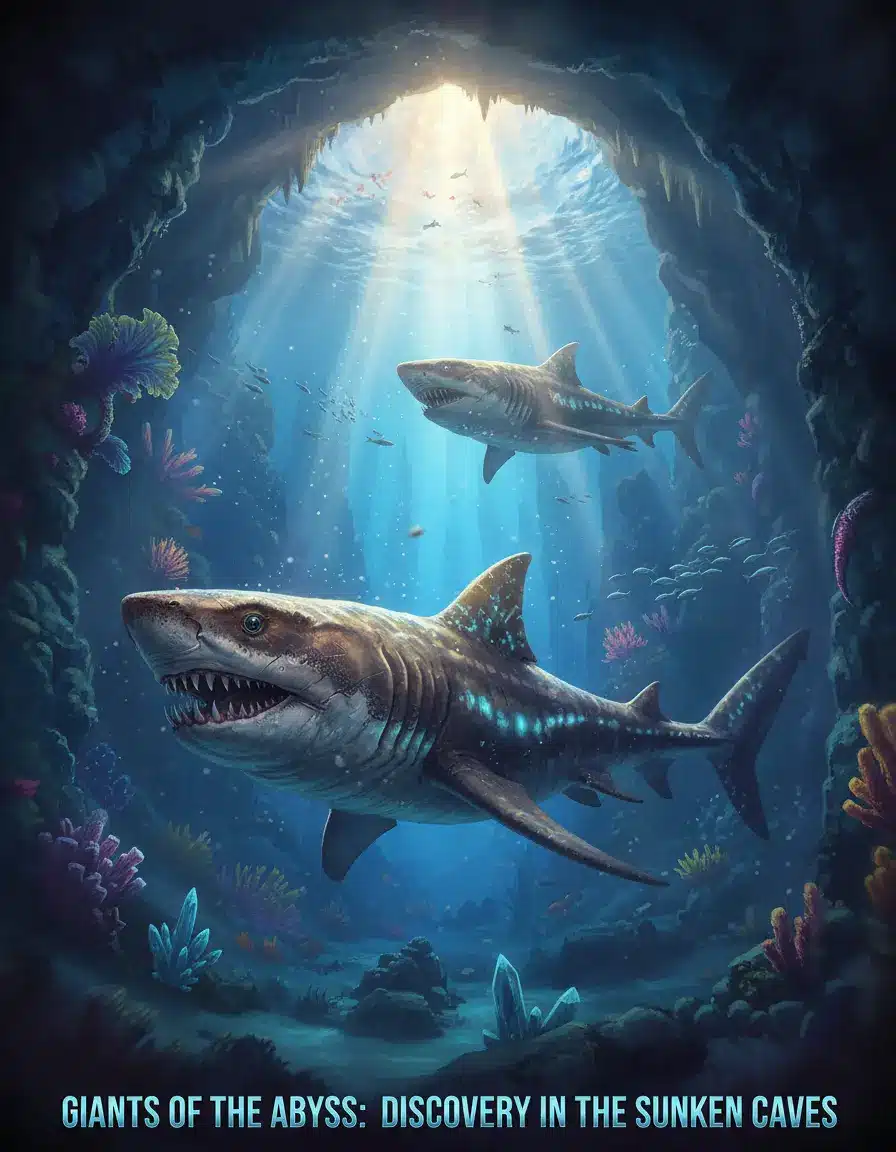
The Carboniferous period, 325 million years ago, wasn’t exactly prime beach holiday territory—but it was, as it turns out, a playground for giant sharks whose fossils are now rewriting the story of prehistoric seas from deep beneath America’s feet. Recent discoveries in the shadowy depths of Kentucky and Alabama have delivered two astonishingly well-preserved shark fossils, their secrets locked away longer than your last childhood diary. Hold on tight: the lost world they reveal is more spectacular than a blockbuster sequel.
Hidden Giants in America’s Underground
- Troglocladodus trimblei (discovered in Kentucky’s Mammoth Cave)
- Glikmanius careforum (uncovered in a mysterious cave in Alabama)
What’s the recipe for discovering 325-million-year-old sharks? Take one of the world’s largest cave networks, Mammoth Cave in Kentucky, drop all sunlight, add relentless humidity close to 98%, and stabilize the temperature at a chilly 13°C. In those conditions, remnants of Troglocladodus trimblei were found, perfectly trapped in limestone. Just months later, the same underground miracle occurred in Alabama, as Glikmanius careforum made its posthumous debut.
Neither of these ancient sites fits the bright, coral-filled image we usually conjure of ancient seas. Instead, their darkness and humidity created a microclimate ideal for fossilization. It’s as if time itself decided to take a nap, forgetting to degrade bones, teeth, even bits of skin or organs. For paleontologists, this sort of preservation is as rare and invaluable as finding buried treasure—and, let’s be honest, way better for impressing at dinner parties.
Why Caves Preserve History Like Nowhere Else
What makes these caves natural laboratories for fossil magic? It comes down to three things:
- Constant humidity: Over 98% keeps tissue from decaying fast.
- Total darkness: No light means no destructive photochemical changes.
- Stable temperatures: Roughly 13°C slows harmful chemical processes to a crawl.
Thanks to this rare environmental balance, bones, teeth, and even slivers of shark “skin” survived undisturbed for over three hundred million years. Occasionally, traces of skin or even mineralized organs surface—offering unprecedented opportunities for scientific analysis. These fossils are so exquisitely preserved that they dare paleontologists to ask new questions about ancient physiology, growth, and behavior.
From Swampy Carboniferous Seas to a Prehistoric Thriller
To picture how these sharks got buried in stone, rewind to when the supercontinent Pangea was assembling. Much of what is now central North America was underwater, lined with life-rich lagoons. As the inland sea withdrew, countless dead marine animals, including these behemoth sharks, were entombed beneath thick sediment layers. Tectonic chaos, rock collapses, and groundwater eventually sculpted the caves, locking away skeletal secrets until humans dared to descend.
Before these specimens emerged, the Carboniferous shark story relied mostly on scattered teeth and poorly preserved bone fragments. Finding articulated skeletons now lets researchers investigate ancient shark lineages, hunting strategies, and how species interacted—or squared off—on primeval food chains.
Rare biological relics, like skin impressions or organic residues, are especially valuable. Upcoming research aims to clarify how these predators grew, lived, and survived, possibly revealing physiological secrets kept off the paleontological radar until now.
Far Beyond Sharks: The Bigger Picture of Lost Ecosystems
The impact of this double discovery reaches beyond jaws and sinew—it illuminates the wild dynamism of Carboniferous ecosystems. Analysis of accompanying sediments and plant relics hints at major climate swings, helping us understand how ancient fauna adapted to (or perished in) shifting seas and continents. The preservation evident here also provides a roadmap for spotting new fossil-rich hotspots in similar cave systems or karst landscapes.
During the Carboniferous, the ocean floor was a bustling wilderness. Imagine dense undersea forests, thick reefs, and more creatures than rush hour traffic, all under the reign of apex predators like Troglocladodus trimblei and Glikmanius careforum. Survival was a game of tooth, trick, and defensive spine, with each tiny advantage tipping the scales in this age-old rivalry of predator and prey. Their abrupt disappearance coincided with Pangea’s transformation—proof that even the best-adapted giants can fall to massive environmental change.
Today, sites like Mammoth Cave, the Alabama cave, and other karst hotbeds in the US are only beginning to reveal their paleontological treasures. Non-invasive analysis, from CT scanning to microradiography, protects these relics as they’re studied. New expeditions—energized by these headline discoveries—could put the US on the map as a global reference for prehistoric giant shark research, all thanks to what the caves decided to save for us.
If you’re hoping for a message in a bottle from prehistory, this is it: keep looking in unexpected places. Sometimes, the world’s greatest stories are hiding right beneath our feet—frozen in stone, waiting for the next bold explorer with a lamp, a hammer, and a sense of awe.
Similar Posts
- 325-million-year-old giants revealed: inside the exceptional discovery of two prehistoric sharks
- 4,000-year-old woman’s face reconstructed: the surprising story hidden in her features
- Sylvester Stallone’s Most Unexpected Role Ever: Prepping His Cardio for Swimming!
- 7000 years: every human today shares these ancient migrant ancestors
- Spielberg Reveals Secrets Behind Jaws’ Most Iconic 4-Minute Scene!

A passionate journalist, Iris Lennox covers social and cultural news across the U.S.