
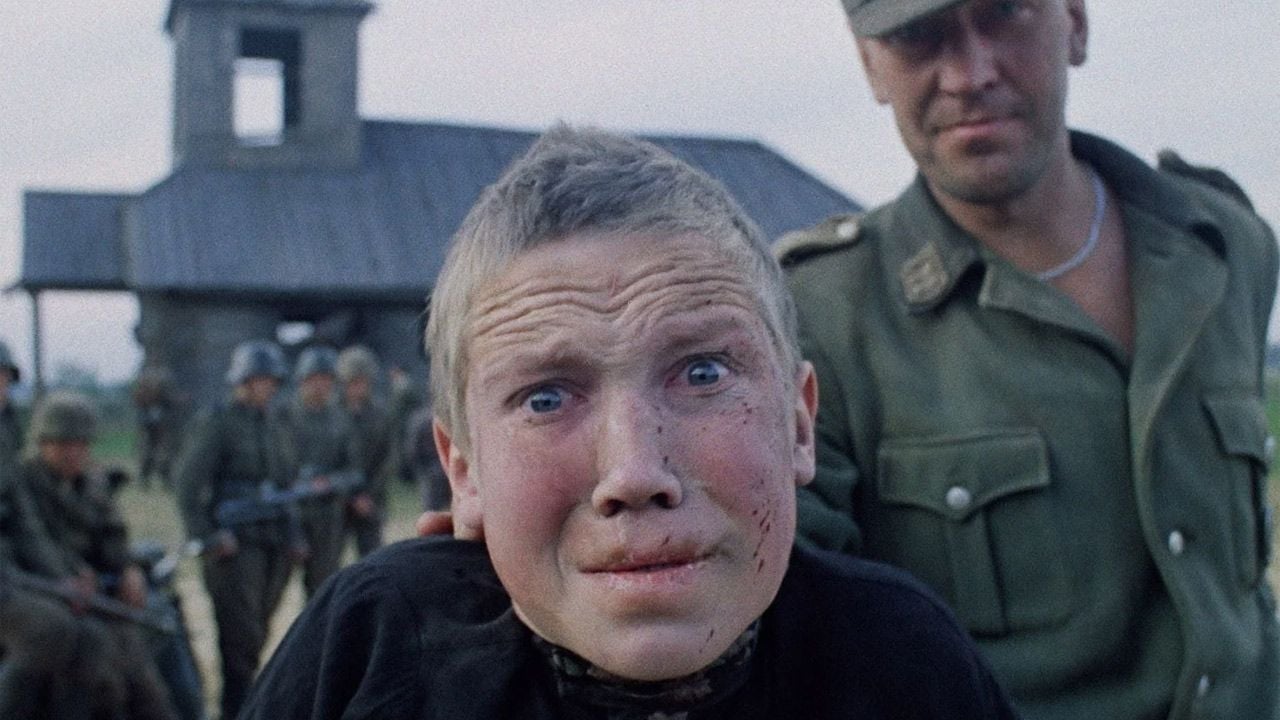
Released in 1985, “Requiem for a Massacre” is a stunning film that immerses viewers in the horrors of war through the experiences of a teenager facing Nazi brutality. This shocking film has become a cult classic.
With its duration, intensity, global scale, terrifying extent of destruction, genocidal nature, and industrial scale of mass atrocities, World War II has always provided fertile ground for cinema, which continues to draw heavily from it. The number of masterpieces set during this conflict is countless—and thankfully so.
While American cinema has logically and often dominated by producing a plethora of narratives about this conflict, there are certainly notable works from elsewhere that have left an indelible mark on filmgoers’ memories. Among these is a Russian film released in 1985: “Come and See,” also known as “Requiem for a Massacre,” by Elem Klimov.
And it has to be said outright: nothing you’ve seen before can prepare you for this astonishing film, which is intense and brutally violent, sometimes even pushing the boundaries of what is bearable. It’s a work unlike any other and one that could not be recreated today. It later earned its well-deserved status as a cult film.
The Brutality of an Inhumane Occupation
In “Requiem for a Massacre,” the setting is very specific, underpinning the horrifically tragic narrative: the German occupation of Belarus from 1941 to 1944, marked by utter barbarism. The Nazis deported about 380,000 people to forced labor and killed hundreds of thousands of civilians there.
It is estimated that more than 9,000 villages were burned or looted in Belarus during World War II. Over 600 villages were completely razed, and their populations massacred. In total, 2,230,000 people, a quarter of the population, were killed in Belarus during the three years of German occupation, including 600,000 to 800,000 Jews from the ghettos of Belarus.
These mass killings and massacres were largely committed by the dreaded Einsatzgruppen; literally intervention groups, which were mobile extermination units of the Third Reich tasked with the systematic assassination of real or supposed opponents of the Nazi regime in the territories behind the Eastern Front.
Based on the testimony of survivors from villages burned by the Nazis in Belarus in 1943, “Requiem for a Massacre” reveals a vision of war through the eyes of a child named Fiora, a young boy from a Belarusian village occupied by Nazi troops.
He joins the partisans, although too young, and with the energy and idealism of a child, he plunges into the horrors of a world that even surpasses the adults. Between wandering and fighting, Fiora becomes a witness to all the horrors of war…
“Those Hellish Impressions Stayed with Me Forever”
The film was a success at the time for the Soviet public, commemorating the 40th anniversary of the country’s victory in World War II. A convergence of cinema and history that would not have occurred had Klimov been able to make the film seven years earlier, as he had planned. This was due to the meticulous and sometimes absurd demands of Soviet authorities, censorship included…
“I felt guilty for not having made my film about the war,” Klimov said in an interview. “In fact, I was born in Stalingrad, and naturally, as a kid, I experienced the bombings, the crossing of the Volga, the exodus to the Urals. […] Those very strong impressions of that hell stayed with me forever, they are still alive in me. I was haunted by the idea that I had a duty to make that film.”
He explained why Soviet authorities demanded that his film’s title be changed to “Come and See.” “When the script was born, it was called ‘Kill Hitler.’ But later, after a gap of seven years, when we were allowed to revisit this theme, we were told that the word ‘Hitler’ had to be avoided. I told them that ‘Kill Hitler’ should be taken in a broader sense than just the individual. But no, the title had to be urgently changed.”
“I then asked my brother to flip through the Gospel a bit. He opened to the passage of the Apocalypse. And he came across the lamb opening the first seal and the voice of thunder saying as a leitmotif: ‘come and see.’ It repeats four times.”
“It Was an Incredibly Difficult Role, Pushing the Limits of Endurance”
To say that his young star, Aleksei Kravchenko, at just 14 years old, delivered an extraordinary performance is an understatement. He had never acted in a film before Klimov’s.
Considering what this young adolescent goes through and the emotional toll that ensues, it would be simply impossible to shoot under such conditions today. Between explosions tearing through the tops of trees in a forest, real machine gun bullets passing 10 cm from his head, not to mention a scene in a marsh that nearly swallowed him alive, it was nine months of filming in hell for him and the team. It left a lasting and even traumatic mark on him. Yet, the young boy’s commitment to his role and the filmmaker was absolute.
“It was an incredibly difficult role, these situations pushing the limits of endurance,” Klimov recounted. Aware that he was subjecting his young apprentice actor to an experience beyond what was possible, Klimov even brought a hypnotist to the set.
“With him, we developed a whole system of defenses, tests, detection, how we would invest in the subconscious, and how not to cause his loss afterward, how to gently offload him. It shows how great our concerns were,” he said.
According to Aleksei Kravchenko himself, filming the terrible scene where villagers are corralled in the village church before being burned alive was the extreme limit of what he could endure. And seeing that sequence is already saying a lot…
“It’s a Half-Mad Film”
A great admirer of the film, having discovered it upon its limited release in France at the time, Nicolas Boukhrief wrote a rave review in the now-defunct magazine Starfix.
“Only Kubrick has given me this type of cinematic ecstasy,” he said in an interview at the time of the film’s DVD release in France. “The film is so violent, especially in the situations it puts its hero through, that it was an embarrassment for the press. The film was too impressive for the critics at the time,” he said, noting that “Requiem for a Massacre” went almost unnoticed in our country. “I think that’s partly because we were still in the midst of the Cold War, that it was seen as a big piece of propaganda, which it is also in part,” he continued.
“It’s a half-mad film, as were works like ‘Aguirre, the Wrath of God’ or ‘Apocalypse Now.’ It’s the last film by Elem Klimov, and that’s not very surprising. It’s a film you don’t come back from,” he added.
The filmmaker himself would not really say otherwise. “After this film, I no longer wanted to make another. It was such a great ordeal, I had to dig so deep into my resources…” he confessed. Adding about his main actor: “Thank God, Aleksei Kravchenko, that kid, didn’t go mad. You would have gone mad for much less…
A seminal film that has influenced entire generations of filmmakers, including Steven Spielberg himself, and will continue to do so, “Requiem for a Massacre – Come and See” is an absolutely unique and extraordinary work. You know what you have to do if you have never seen this extraordinary film.
Similar Posts
- First Look at Moulin: Gilles Lellouche in His Darkest, Most Powerful Role Yet!
- Stallone Calls It His Best Action Movie Ever, Despite Harsh Criticism!
- Russell Crowe’s Massive New Role Challenge: First Look at Upcoming Film!
- Matthew McConaughey Played a Villain 21 Years Ago in a Failed Cult Saga Movie, Rated 1.1/5!
- Israeli Tent Tragedy: Identity of Palestinian Victim Revealed

A passionate journalist, Iris Lennox covers social and cultural news across the U.S.