
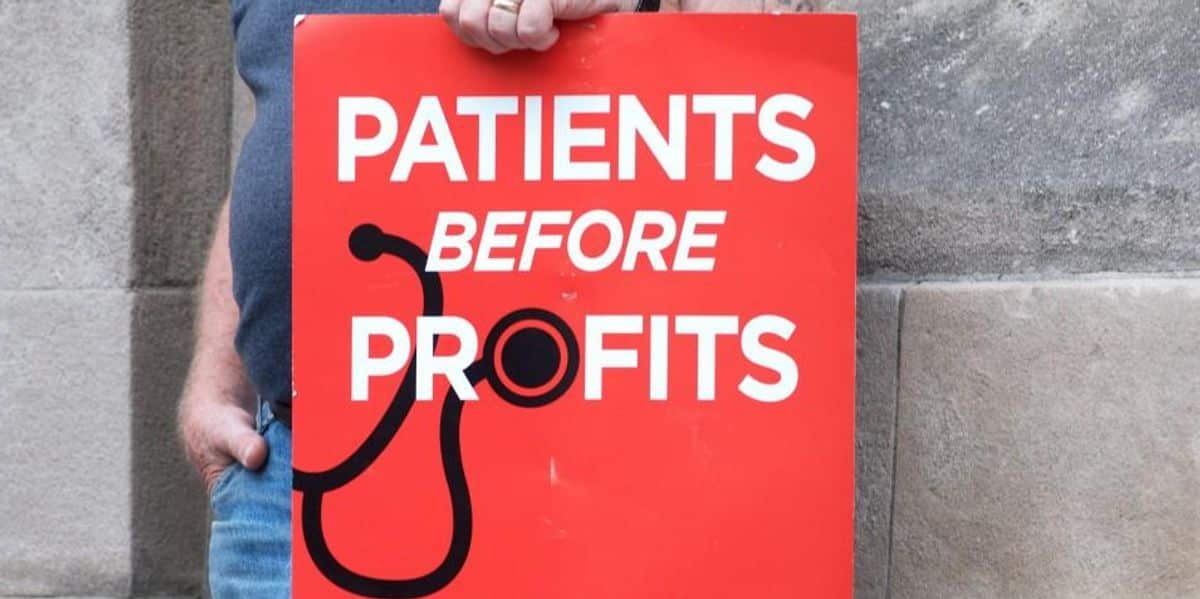
Recently in the United States, a wave of anger has swept across the nation following the murder of UnitedHealthcare CEO Brian Thompson. This event has ripped open the widespread discontent with the health insurance industry. No political spin or media critique can mask the fact that Americans across the political spectrum are outraged by the current state of healthcare.
In this century, Americans have seen their healthcare system deteriorate rather than improve. Gallup polls indicate that public satisfaction with healthcare quality is at its lowest since 2001. More notably, these polls reveal that Americans view healthcare coverage even more negatively than healthcare quality itself.
The primary failure lies in healthcare coverage, largely due to the insurance industry’s profit-driven model which often results in denied care.
This situation is a classic example of market failure. Rather than competition driving down prices and boosting quality, a few dominant players have created an oligopoly that inflates costs and leaves millions without insurance.
The political landscape seems to avoid these harsh realities, with little attention given to healthcare by leading politicians. Journalist Ken Klippenstein highlighted that major political figures like Kamala Harris and Donald Trump only mentioned healthcare briefly in their convention speeches, despite its critical importance in past elections.
As a result, Americans face soaring premiums, overwhelming medical debt, and denied treatments, pushing public frustration to its limits. It’s increasingly clear that insurance companies prioritize shareholder profits over consumer health.
Economist William Lazonick argues that consumers are entitled to quality care at a fair price, suggesting that a single-payer system could ensure this by covering costs more effectively. He criticizes companies like UnitedHealthcare for choosing profit over patient care by denying claims and delaying payments.
This represents a capitalism that has spiraled out of control.
Despite these issues, profits in the insurance industry are booming. Lazonick points out that UnitedHealthcare’s operating profit margin hit 8% on revenues of $281.4 billion in 2023. Insured individuals not only pay high premiums but also face deductibles, copays, and unexpected bills. He argues that these insurers exploit the system by enrolling primarily young, healthy individuals and manipulating costs, largely enabled by policies like the Affordable Care Act’s individual mandate.
Lazonick, along with his colleague Oner Tulum, notes that major insurance firms have aggressively bought back their stock, a move that pads profits and executive wallets at the expense of the public. They report that from 2000 to 2017, former UnitedHealth Group CEO Stephen J. Helmsley earned an average of $37.3 million annually, mostly from stock-based compensation, illustrating the deep-rooted financial incentives in the industry.
The death of Brian Thompson, who profited greatly from these practices, has not been widely mourned, possibly due to his role in perpetuating this harmful system.
The issues stem from a neoliberal ideology that prioritizes profit over care, treating health as a market commodity rather than a human right. This approach has only widened the gap between the wealthy and the average American, with the former gaining access to superior healthcare while the latter suffers.
Many Americans see through the facade of an efficient, competitive health insurance market. In reality, a few powerful insurers dominate the market, focusing more on profit extraction than on providing care. Let’s examine three specific market failures.
1. Information Asymmetry: In a truly competitive market, clear information would be available to make informed choices. However, in the U.S. health insurance market, companies deliberately obscure important details of their policies, leaving consumers confused and powerless.
Consider a self-employed individual choosing a health plan from the Health Insurance Marketplace without subsidy eligibility. They might select a silver plan costing $1,000 monthly, thinking they are covered for in-network doctor visits with a reasonable co-pay. Yet, a visit to the doctor reveals a $200 charge because the deductible was not met—a detail buried in fine print.
This scenario exemplifies not only the deceptive practices in the Marketplace but also the government’s limited role in a system controlled by private insurers.
2. Adverse Selection: When faced with high out-of-pocket costs, healthier individuals might opt out of necessary healthcare to avoid expenses, a behavior that insurers indirectly encourage. This leads to a cycle of rising premiums and decreasing access to care.
3. Externalities: The lack of universal coverage produces negative externalities. For instance, an individual avoiding upfront medical costs might end up in the emergency room, where treatment is more expensive. This not only increases healthcare costs for everyone but also places a heavier load on public resources and spreads illness.
Medicare Advantage is often touted as beneficial, but Eileen Appelbaum calls it a scam, particularly harmful to those with severe health issues. She explains that these plans often deny necessary care and delay treatments, jeopardizing patient health.
Ultimately, the U.S. healthcare system’s reliance on private insurers and their administrative complexities contrasts starkly with more efficient single-payer systems. The current system not only fails to provide necessary care fairly but also exacerbates social inequality.
Documentary filmmaker Michael Moore has argued for a complete overhaul of this system in favor of a single-payer model, where health is treated as a public good, not a commodity.
The American public is increasingly prepared to reject the current health insurance model, which enriches a few at the expense of many. It’s time to overhaul a system that operates against the needs of its people.
America is ready to dismiss the year-round Grinches of the health insurance industry.
Similar Posts
- 62% of Americans Demand Government Guarantees Universal Health Coverage!
- UnitedHealth CEO Confronts Flawed System After Tragic Killing
- Jayapal and Sanders Respond to Elon Musk’s Healthcare Cost Query!
- Shocking: UnitedHealth Interrupts Cancer Surgery to Question Its Necessity!
- Sanders Champions Medicare for All to Make America Healthy Again!

An economic reporter, Dax Everly breaks down financial trends and their impact on Americans’ daily lives.