
In 1990, Robin Williams portrayed one of his most unforgettable characters in a cinematic masterpiece, delivering an absolutely iconic line. Here’s a look back at two small words that changed the lives of millions.
On January 17, 1990, “Dead Poets Society” made its debut in France, creating a massive impact. Directed by Peter Weir, the film became a phenomenon, attracting 6.5 million viewers!
Globally, the movie grossed $235 million against a modest budget of $16 million, marking it as an undeniable success both critically and commercially. The story introduces us to Todd Anderson, played by a young Ethan Hawke, a rather shy boy who is sent to the prestigious and stern Welton Academy in the United States, where his brother had excelled. It is here that he meets an unusual English teacher, Mr. Keating, who encourages his students to constantly challenge the status quo. Mr. Keating’s classes profoundly change the lives of the reserved student and his friends.
Beyond the movie, this extraordinary teacher has left a lasting impression on generations of viewers, with his life lessons echoing far beyond a mere classroom. Robin Williams, who plays Mr. Keating, brought his whimsy and humanity to this memorable character, making him as humorous as he is poignant.
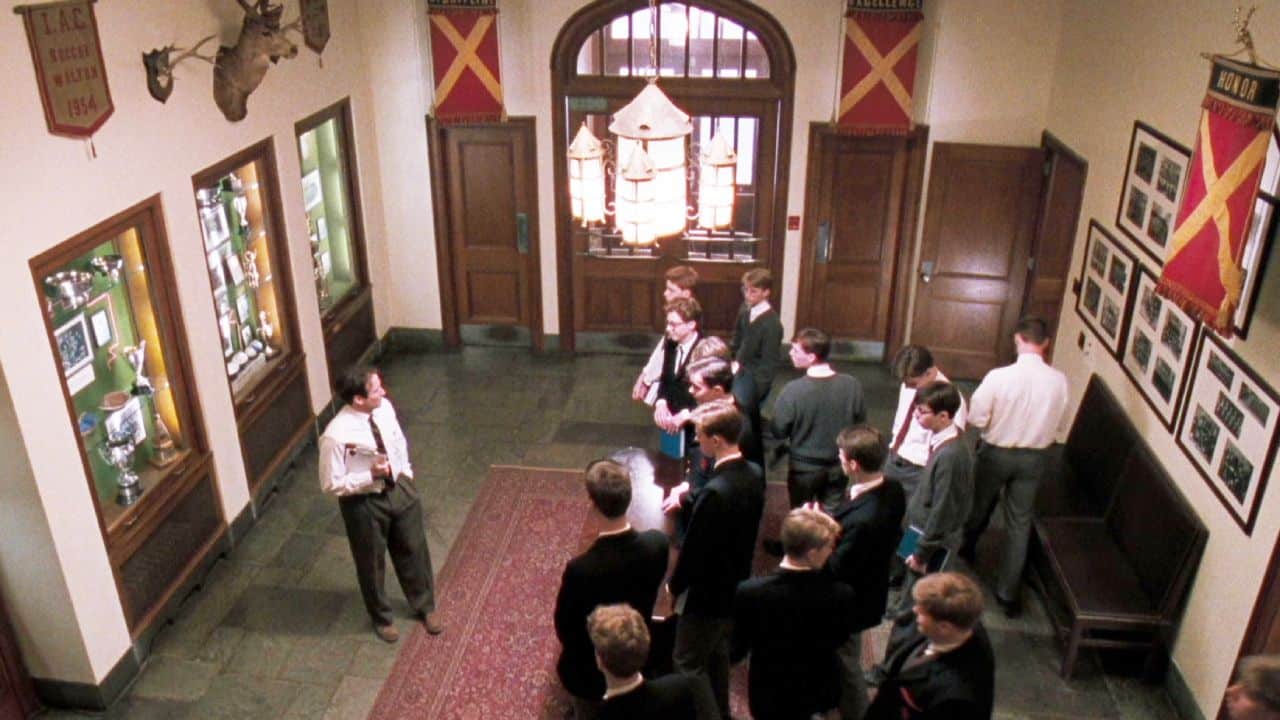
From his very first scene, Keating is immediately seen as a nonconformist. He takes his students out of the classroom and leads them to the front of the school for a first lesson they will never forget, one that has remained etched in the minds of viewers.
The teacher asks Mr. Pitts to open his book to a poem on page 542: ‘O Virgin, do not lose hope’. “Gather ye rosebuds while ye may, Old Time is still a-flying, And this same flower that smiles today, Tomorrow will be dying.”
Two Words That Changed Everything
“Gather ye rosebuds while ye may”, Mr. Keating repeats. “In Latin, it was said like this: Carpe Diem,” adds the teacher, with enthusiasm and vigor, ensuring the students remember the lesson. Initially skeptical, the students begin to truly listen to this peculiar character, who is the polar opposite of the academy’s archaic methods.
In Latin, it was said like this: Carpe Diem.
“Seize the day,” Keating continues, translating the two words from Latin. “The poet wrote this because one day worms will eat us. Each of us will stop breathing, will turn cold, and will die,” he tells his students, inviting them to look at the portraits of past students in the glass case, all whispering “Carpe Diem, make your lives extraordinary.”
Director Peter Weir stages this scene as a moment frozen in time. Keating speaks softly, almost whispering behind his students. This requires the students to listen intently, and the audience as well. The teacher also creates physical closeness, prompting them to lean towards the frozen faces. The whispering makes the moment intimate, almost secretive.
By creating these pauses, he establishes a solemn, almost funereal atmosphere. It becomes clear that these once hopeful young men are now deceased. The message thus becomes concrete for the current students: time flies, and every second must be cherished. For these young men, this idea is crucial, starkly contrasting with their school environment.
Defying Conformity
Indeed, these photographs represent tradition, conformity, and discipline. But Keating’s message completely counters everything the school stands for. These two words, Carpe Diem, challenge the institution’s rigid rules. In an environment that dictates a predetermined future (prestigious careers, academic success), Carpe Diem encourages students to think for themselves and live according to their own desires.
For adolescents and young adults still forming their identities, this call to transgression is irresistible. And that is precisely what some of Keating’s students do, by reviving the Dead Poets Society. This scene in the film is thus pivotal as it triggers the characters’ evolution.
Todd, Neil, and others begin to dare—to write, act, love, assert themselves. Although the outcomes are sometimes tragic, the phrase becomes a catalyst for transformation. Moreover, “Carpe Diem” has become a universal cultural symbol, associated with the ideas of freedom, authenticity, and courage against social expectations.
Ultimately, this line is striking for all viewers because it encapsulates the central theme of the film: to dare to live fully and choose one’s own path, even in a world that wants to make decisions for you. It’s a powerful lesson that we all keep in the back of our minds, accompanying us throughout our journey.
And if you feel like watching “Dead Poets Society” again after reading these few lines about the famous “Carpe Diem,” you should know that the film is available on Disney+!
AlloCiné, with daily articles about film and TV news, interviews, streaming recommendations, and quirky facts about your favorite movies and series, ensures you explore the riches of a site designed by enthusiasts for enthusiasts every day. Subscribe to AlloCiné on Google Discover to continue exploring daily.
Similar Posts
- Robert Downey Jr vs José Garcia: Why Marvel Paused This Crazy Project!
- Harrison Ford and Russell Crowe Owe Everything to This Forgotten Legend!
- Robin Williams’ Last Film: What Was It, 11 Years After We Lost Him?
- Must-Watch! New Documentary on a Children’s Class Will Move You Deeply!
- In Japan: A father of two is the only parent to pick up his 7-year-old son, who goes to school on his own.

A passionate journalist, Iris Lennox covers social and cultural news across the U.S.