
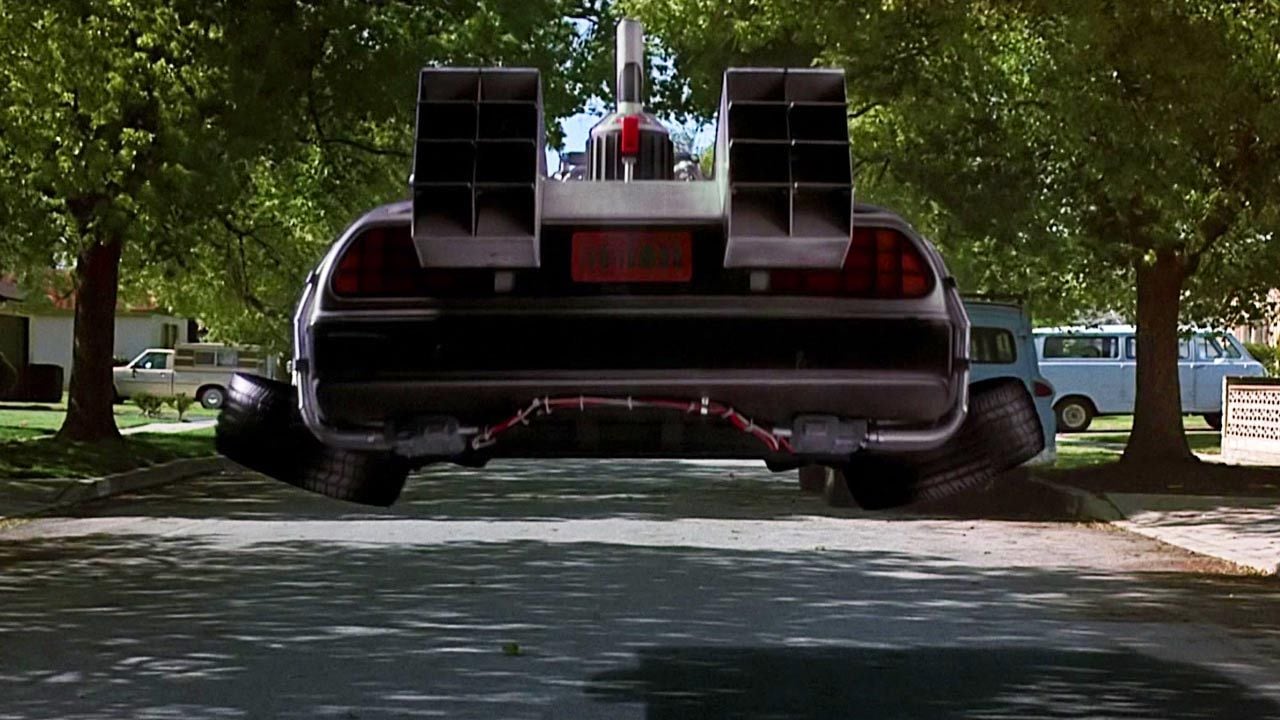
What if the ending of “Back to the Future” had been completely different? Originally, Marty McFly was supposed to survive a nuclear explosion! Explore this darker, abandoned version that would have altered the history of this iconic film.
Today regarded as one of the greatest science fiction classics, “Back to the Future” could have had a drastically different conclusion. Before settling on the now-famous ending involving lightning and the clock tower, the writers had envisioned a much more spectacular—and decidedly darker—sequence.
A Nuclear Explosion Instead of Lightning
In the film everyone knows, Marty McFly (Michael J. Fox) travels back to 1985 using the power of a lightning bolt captured by the DeLorean. However, the original storyboards told a completely different tale. In 2016, 113 previously unseen storyboards drawn by Andrew Probert, the film’s artist, were discovered. These were sold for $6,000 and publicly displayed for the first time.
In this scrapped version, the military is preparing a nuclear test in the desert. Several individuals are in the test tower when they spot a DeLorean speeding towards them. Doc Brown (Christopher Lloyd), over the radio, has precisely calculated the exact moment Marty rushes onto the site. There are some similarities with the film’s ending—Doc finds the letter foretelling his 1985 death, and the old car refuses to start. But everything else is different: a countdown begins: 5, 4, 3, 2, 1… and the bomb explodes just as Marty hits 88 mph. A nuclear bomb detonates behind him, completely destroying the mock city built for the test, before the DeLorean miraculously reappears in 1985.
Back in 1985, visitors are gathered at the site of the former nuclear test. As a guide tells them about the strange phenomena rumored to have occurred there, a flash of lightning and a gust of wind mark the reappearance of the DeLorean. Marty McFly is back home, and his DeLorean, which struggled to start, has miraculously survived a nuclear explosion.
Why This Ending Was Abandoned
This spectacular idea was never realized, primarily due to budget constraints.
Bob Gale, co-screenwriter of the film alongside Robert Zemeckis, explained to Collider in 2020, “The most expensive part was the outdoor shooting and building that city. We thought if we could eliminate that step—if we could avoid outdoor shoots and building the city and film at a location we already owned, namely the outdoor studio—we’d easily save a million dollars.” The studio was thus looking to cut production costs, leading to the abandonment of this particularly ambitious sequence.
A Better Ending for Marty and Doc
In hindsight, this change likely served the film well. The chosen ending provides a real moment of tension and triumph: Marty returns to his time, his family enjoys a brighter future, and Doc escapes death.
Conversely, an ending centered around a nuclear explosion would have significantly altered the tone of this family adventure and cast a shadow over the outcome: no one wants to think about nuclear war while watching a comedy about time travel. The story of Marty and Doc is based primarily on ingenuity, humor, and emotion, much more than on spectacle at all costs.
Another change was made: Doc was originally supposed to tear up Marty’s letter and throw it into the DeLorean. Andrew Probert convinced Bob Gale that Doc should instead slip the pieces into his jacket, arguing that it would make his survival in the present truly surprising. “If you’re not prepared for it, you miss the fact that he doesn’t know the purpose of the letter… because it doesn’t matter anymore,” Probert explained to Syfy WIRE. “So Bob said, ‘Okay, let’s do a storyboard and see what it looks like.’ I did, and it worked.” Indeed, this reinforces the triumphant feel of the ending.
An Idea That May Have Inspired Indiana Jones
Interestingly, this abandoned version also included a refrigerator used as shelter from the nuclear blast. This scene strongly recalls “Indiana Jones and the Kingdom of the Crystal Skull,” where the famed adventurer survives a nuclear detonation by hiding in a refrigerator.
According to actor Jon Cryer, who had auditioned for the role of Marty McFly, this scene was indeed in one of the early versions of the script. “Does this sequence remind you of something?“, he quipped on X (formerly Twitter) in 2020.
A Tendency to Remove Dark Scenes
While the apocalyptic ending of “Back to the Future” was never filmed, some darker scenes were indeed shot and are still visible today. In “Back to the Future II,” Marty finds himself in an alternate reality where Biff (Thomas F. Wilson) has become wealthy thanks to the sports almanac from the future. Instead of using this wealth for good, he has built a massive casino and tower while Hill Valley, plagued by crime, deteriorates around him. In a deleted scene, Marty, confronting this alternate Biff, stumbles upon his brother Dave (Marc McClure), who has become a disheveled alcoholic. Before Marty can help him, Dave flees.
In another deleted scene from the third chapter, the atmosphere was even darker: the sheriff of Hill Valley of 1855 (James Tolkan) is shot dead by Buford Tannen in front of his young son. This sequence, intended to make Buford more threatening, was wisely removed from the final cut.
Bigger Isn’t Always Better
Nearly forty years after its release, “Back to the Future” remains a model of balance between adventure, humor, and emotion. The nuclear ending would undoubtedly have been more spectacular, but it would also have deprived the film of what still makes it strong today: watching Marty and Doc Brown triumph through their resourcefulness rather than amidst a nuclear mushroom cloud.
The “Back to the Future” trilogy is available to watch on Disney+.
AlloCiné features daily articles on the latest in film and TV, interviews, streaming recommendations, quirky facts and cinephile anecdotes about your favorite movies and series. Subscribe to AlloCiné on Google Discover to explore daily the riches of a site designed by enthusiasts for enthusiasts.
Similar Posts
- For 40 Years, Everyone Missed This Film’s Title Revealing the Final Scene!
- Back to the Future 2 Nailed It: How One Scene Predicted Hollywood’s Future 31 Years Ago!
- Michael J. Fox Recalls First Bizarre Meeting with Spielberg: “I Slapped Him on the Back!”
- Back to the Future 2: Meet the Film’s Funniest Faceless Character!
- 34 Years Ago, This Epic Chase Scene Became a Cinema Icon and Still Thrills!

A passionate journalist, Iris Lennox covers social and cultural news across the U.S.