
Add Allociné to your favorite sources
Can we ever truly understand those we love? With “Your Maternal Animal,” premiering today, Valentina Maurel delivers a powerful and perplexing film about the bonds that unite us in a world where nothing seems quite certain anymore.
Partner content
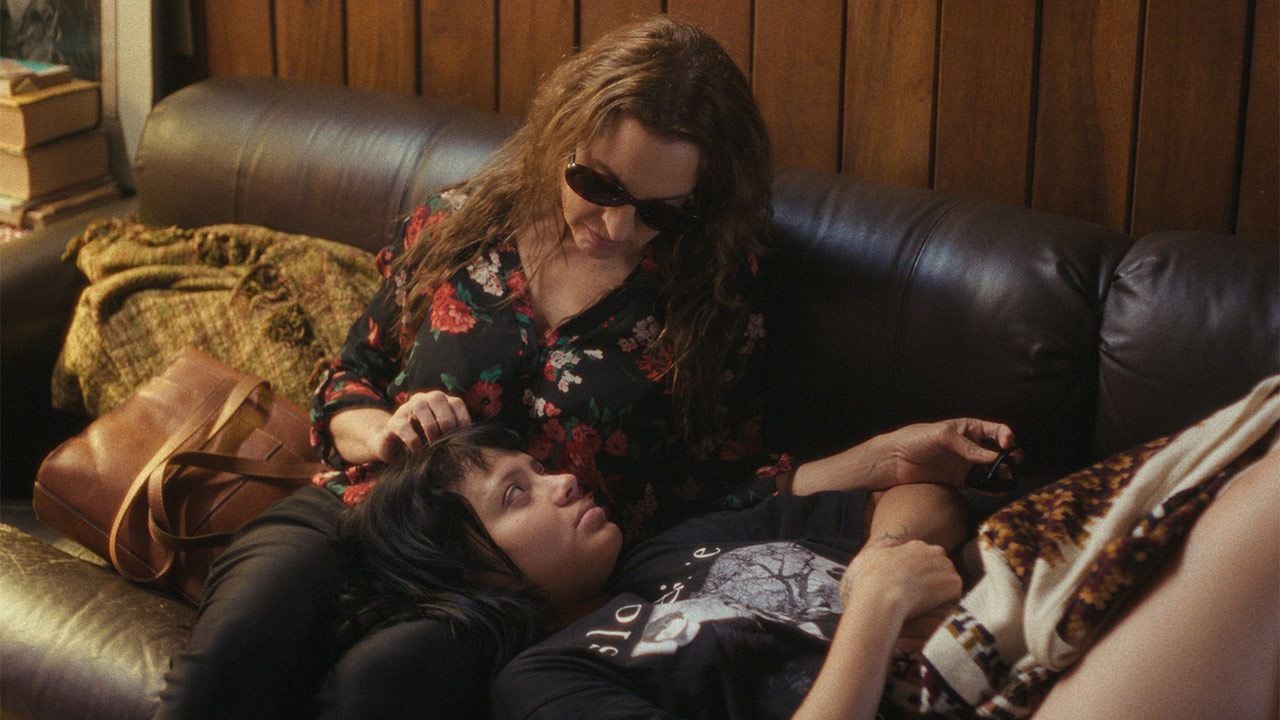
Returning to Costa Rica after studying in Europe, Elsa reunites with her younger sister Amalia, who is alone in their family home. Increasingly elusive, Amalia appears to be trapped in esoteric beliefs. Elsa attempts to alert their parents, but neither her father, preoccupied with his new romantic pursuits, nor her mother, engrossed in republishing the erotic poems of her youth, seem to grasp the gravity of the situation. Elsa’s return prompts the three women to examine their unbreakable bond.
When Differences Shape Family Relationships
Franco-Costa Rican director and screenwriter Valentina Maurel made her debut in 2022 with “I Have Electric Dreams,” which earned her the award for Best Direction at the Locarno International Film Festival, while actors Daniela Marín Navarro and Reinaldo Amien received accolades for their performances. Continuing with these talented actors, her second film “Your Maternal Animal,” in theaters this week, confirms the emergence of a filmmaker with a deep sensitivity for intimate relationships and complex family dynamics.
With this new feature, Maurel further explores the dynamics within a family. At the story’s heart are two parents who separated ten years ago and their two daughters. The characters are alternately endearing, cowardly, or detestable, which Maurel refuses to simplify. Speaking of Isabel, the mother—played by renowned Mexican stage actress Marina de Tavira—she explains, “Nothing of her selfishness is erased, yet she is given the chance to be moving, or at least human. Isabel contradicts herself constantly, like many of us.” This approach roots the narrative in reality, reflecting our own family relationships.
Elsa, the elder sister (Daniela Marín Navarro), studies anthropology in Belgium. Deeply influenced by European culture, this independent, educated young woman, comfortable with her body and possessing a very rational and atheistic view of the world, returns to her native Costa Rica with a changed perspective. In contrast, her younger sister Amalia (Mariangel Villegas) dropped out of school and squats in the family home, which she lets fall into disrepair. She hosts several outcasts who share her beliefs in God, spirits, and ghosts. This lifestyle worries Elsa, who judges her sister and struggles to reason with her while trying to help.
Yet behind this desire to “fix things” lies a cultural gap. The director explains, “The very European way the older sister wants to help, fix, and save doesn’t fit with how this country operates, especially by giving a significant role to poetry, magical or spiritual dimensions, and religion… Costa Rica negotiates with reality as best it can.“
However, “Your Maternal Animal” does not attempt to declare who might be right. While Elsa seems to have found her path in Europe, her need to understand and organize does not necessarily make her happier. Indeed, she still feels the need to return to her home country. Amalia, on the other hand, has chosen a radically different path. As for their parents, they seem disconnected from their daughters’ concerns. Each appears primarily focused on experiencing a new youth: taking time for themselves, starting anew, or even resorting to surgery.
Returning to one’s homeland, the growing distance from our family, the upheavals accompanying each stage of life—Valentina Maurel explores what binds us to others, as well as what separates us. To those who stay and those who leave, to those who keep the customs of their country and those who adopt other ways of living. This illustrates that even within the same family, each person may have their own way of dealing with reality.
How to Keep Believing in an Increasingly Absurd World?
In a world where traditional landmarks are dissolving, what does it still mean to believe? With “Your Maternal Animal,” Valentina Maurel aims to explore what it means to be “lost in a small country and a post-truth world, where the existence of God is as unverifiable as some absurd conspiracy theories.”
This ambiguity is central to the character of Amalia. Does her mystical sensitivity stem from a genuine spiritual experience, an aesthetic stance, a way of inhabiting the world, or a psychological disorder? The film does not seek to definitively answer. For the director, the distinction itself has lost its significance: “But she evolves in a universe where, precisely, the question of what is ‘true’ may not be essential.” Instead of establishing a definitive truth, the director allows multiple perceptions of reality to coexist.
Belief is also conveyed through art, particularly poetry. The mother, a recognized erotic poetess in her youth—like the director’s mother—drew strength from her texts to face her life as a woman and mother. Elsa, for her part, is interested in painting. In a daily life sometimes devoid of landmarks, art then becomes another way to make sense of the world and to bring some beauty into it.
This search for beauty extends to the choice of setting. Valentina Maurel chose to film San José, the city where she grew up, far from the tourist image one might expect of Costa Rica. A city where buildings are regularly razed to make room for parking lots, crossed by a Pan-American highway bustling with huge cargo trucks. She explains, “Filming this city that everyone, starting with its inhabitants, finds ugly, even horrible, represented a real challenge for me (…) And the fact that it is difficult to grasp, that it is impossible to cast any tourist gaze on it, makes me want to film it all the more.“
This approach ultimately sums up the film’s ethos: not to artificially beautify reality, but to find how to look at it differently. For its director, “truth is not a theory, a subject, but a lived experience. And we make, as we watch, films not to learn things, nor even to find ourselves, but to lose ourselves.” A conception of cinema that invites not so much to find answers as to accept being unsettled.
What if the hallmark of good films was to leave us with more questions than answers? “Your Maternal Animal” is one such film: a strong, disturbing, and unique work, hitting theaters this week.
Similar Posts
- Elsa Bois Reveals Failed Surprise When Joining ‘Ici Tout Commence’ Series!
- After 7-Year Hiatus, Acclaimed Director Returns with Venice Festival Hit Movie
- Shocking Reason Why This Character is Missing from Many Disney Classics!
- Cassandre: Intriguing Trailer Unveiled for Drama Based on True Story
- A child meets a dog in the street—and what happens next is truly unbelievable

A passionate journalist, Iris Lennox covers social and cultural news across the U.S.