
Add Allociné to your favorite sources
Newly inducted into the elite group of two-time Palme d’Or winners at the Cannes Film Festival, Cristian Mungiu discusses his approach to “Fjord” and his method for tackling very current topics.
The list includes Francis Ford Coppola, Bille August, Emir Kusturica, Shohei Imamura, Jean-Pierre and Luc Dardenne, Michael Haneke, Ken Loach, and Ruben Östlund. Now, ten filmmakers can boast having won the Cannes Film Festival’s Palme d’Or twice, with Cristian Mungiu joining their ranks last May. Having previously won in 2007 for “4 Months, 3 Weeks and 2 Days,” he clinched the award again this year with “Fjord.”
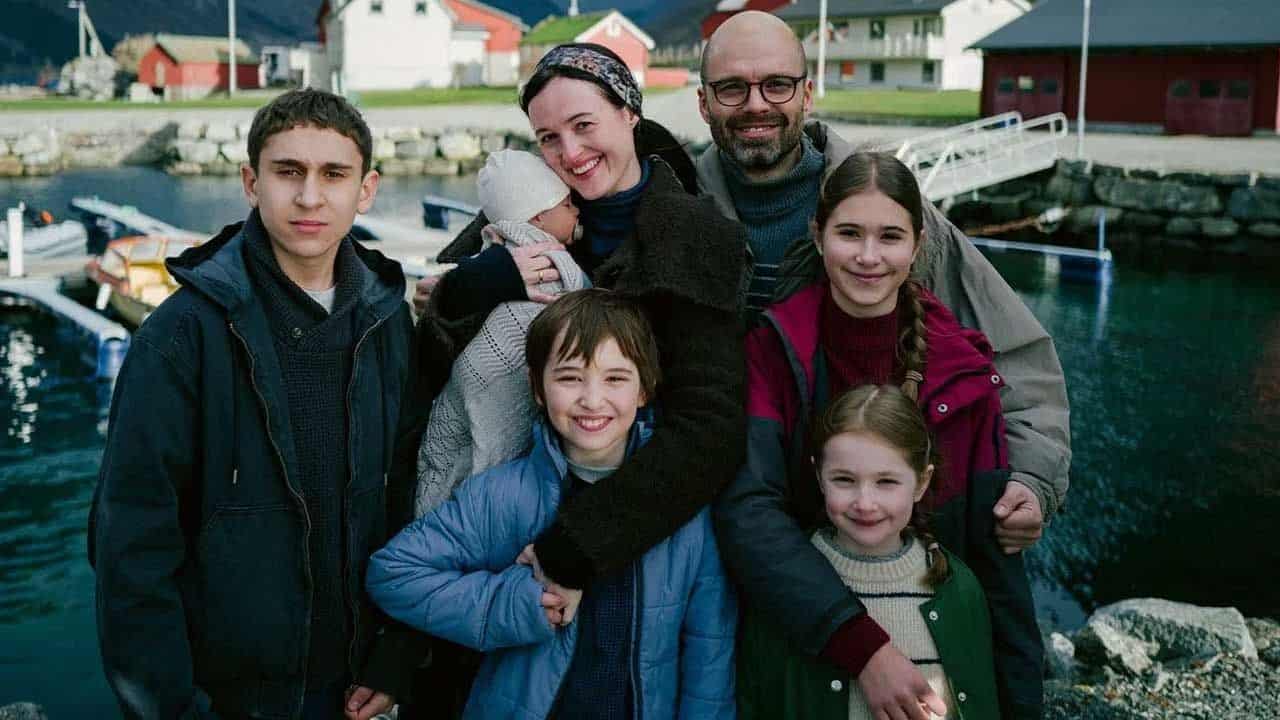
The title “Fjord” refers to the landscape where Mihai and Lisbet Gheorghiu (Sebastian Stan and Renate Reinsve), a Romanian-Norwegian couple, settle with their children and conservative values, which quickly foster a friendship with their neighbors, the Hallbergs, in the village. However, when bruises are discovered on their daughter’s body, accusations from the community trigger a spiral of investigation, where every aspect of their lifestyle comes under scrutiny.
Mungiu, still keen on examining human nature with the realism of his journalistic background, delivers a drama with thriller elements. He discussed the film with us a few hours before its official screening at Cannes, under grey skies that mirrored the world he portrays on screen and the complexities he aims to explore.
AlloCiné: “Fjord” doesn’t carry the “Inspired by a True Story” tag, so I presume it’s fictional, yet everything in it feels incredibly real. Did you draw on real events at all?
Cristian Mungiu: Yes, there’s almost always a real event that sparks my films, and it’s the same with Fjord. There have been numerous incidents related to this topic, and about ten years ago, I began reading articles. After the second, third, fourth article, I realized they spoke of something specific, the kind of societal division we see today, where conflicting values create divisions. I thought this might be the most crucial topic because it explains a lot, including the kind of hatred we all harbor.
And it’s not just in Romania or Norway. If you look at France or the USA, there are groups fostering this hate, deeming others utterly foolish, wishing them gone simply because they don’t share the same values. That’s when you wonder how we’re going to advance, how we can live alongside others if societies continue to be this divided. I thought it would be worthwhile to find a story to discuss this, even though the stories I read weren’t only happening in Norway.
There were instances in Denmark and Sweden too, as these conflicts are most articulately expressed in Northern countries, which are more progressive than those in the South. After extensive research, I decided not to recount a single true story but to create a fiction incorporating various details I found in press reports or from discussions with locals. However, I didn’t include anything that I hadn’t found in one of these narratives.
“You wonder how we can live with others if societies continue to have this type of division”
Indeed, conservatism seems to be gaining ground worldwide, yet stories often depict them as antagonists. You’ve taken a different approach, occasionally making the progressives the antagonists. It’s an unexpected perspective.
That’s what cinema should do! It shouldn’t just confirm the values you already hold but should challenge you to think about others and to step outside the notion that we already know the truth. That’s the challenge of the film. And I managed to do this because I suddenly talk about a minority in a country where the majority holds progressive ideas. Logically, if you hold progressive views, you should defend minorities.
What do you do when the minority belongs to a majority that doesn’t defend you? What happens when you tell a story in a country where they are in the majority? They don’t respect you, but does that mean you should do the same? I don’t think so because you always feel that you share superior values, like tolerance for others. But tolerance comes after listening to and understanding others. It’s difficult, but that’s how you begin to break the dialogue.
And that’s why I think this is a film about all of us, about the need to understand that what’s important with the film, for me, is just a stimulus for you as a viewer, as a citizen, to figure out how we can find a solution ourselves. We can’t continue to live in societies that are so radicalized.
“Fjord” successfully makes us sympathize with the main characters, or at least find their fate unjust. Did you find this balance in editing, by cutting parts that might have tipped the scales more towards one side or another in this power struggle?
No, because I shoot a lot in long takes, so you can’t find anything in the edit. And the script is always most important to me: you have to seek and find that balance when you write, then re-read your own script to see if you’re favoring one side. You must respect everyone’s viewpoint because it’s important to me to always make characters ambiguous. They’re not vehicles for meaning, and I want to make a film that tells a story, not to transmit a message.
Every story carries a certain level of ambiguity that is typical of reality, and that’s what I try to include in the script before I even start shooting. When you shoot like I do, which is in the most challenging way possible, it doesn’t leave you the option to change things during post-production: if the piece of life you’ve recorded works and feels credible, you use it. Otherwise, you can do nothing. That’s why I always try to talk with the actors, giving them a text that already contains these kinds of ambiguities.
We of course discuss during the shoot, but not directly about this. We mainly try to naturally bring out all the decisions you’ve made. If you start talking about conceptual things with the actors, you’re lost. You need to give them directions, but the meaning arises from a mix of everything you’ve written before and what you get on set.
Did you have the end of your story in mind before you began writing, or did it come naturally as you wrote?
Not necessarily, but things were simpler here because most of the stories that inspired me ended this way. With these people leaving. So it was quite obvious, but I hope that the ending we have in the film leads to another level: about the overall meaning, about the story of friendship between these children, about their need to live in another world where it’s not their parents who decide for them, the values they want to share together… In this sense, the most important thing I need to know when I start writing a screenplay is the ending. It’s the vector that gives you the direction of what you’re writing.
“The characters are not vehicles for meaning, and I want to make a film that tells a story, not transmit a message”
Why did you choose to make the setting, the fjord, the title of your film?
It signifies a kind of coldness but also a society based on very clear rules, as much as the air when it’s cold. I come from a country where the law is tougher—even though it’s something general, that you shouldn’t always respect. But not there. Everything is so clear that there’s no room for discussion, and I have a lot of respect for that, it creates a surge of energy.
And it also speaks of something else: we all share a lot of stereotypes, clichés about each other. The French are like this, the Germans like that… And we associate the Norwegians with a kind of coldness, but that’s not the feeling I get regarding emotions. You really need to take the time to understand the other, the fact that they have parents, children, or the same problems as you. It requires a bit of an effort in communication, which always starts with the willingness to listen to the other to see that the differences aren’t that big.
The fjord also embodies this idea of confinement, with this community having only one way in and out. For me, that goes along with your idea of the fjord as a microcosm of the current world.
It’s a microcosm, but also this idea that you’re in a very small community, which isn’t necessarily very open to sharing others’ values because, to begin with, you have very little contact with them. In the Nordic countries, Norway has adopted a policy that results in little immigration. They protect themselves, but many people we met while filming told us they weren’t very proud of it, as the population is quite small relative to the territory, even though it respects this right to decide for itself.
But if you look at what’s happening in Sweden and Norway, you see that integrating different ideas isn’t always straightforward. There’s no one model that works and that you can apply. You really have to try to understand how to find this respect for the other, even if you want to be very open in today’s global society.
This is the first time there are recognized actors in your cinema: was this an intentional choice, or was it just chance in casting that Sebastian Stan and Renate Reinsve ended up being the best to embody this story?
It’s a bit of both. I’ve wanted to work with Sebastian for ten years, whom I met in the USA and who is the only well-known American actor of Romanian origin, and I had no other choice if he refused because I couldn’t find anyone else who spoke even a bit of Romanian. And for Renate, it became obvious after our meeting: I had seen the films she did with Joachim Trier, but I didn’t know how she worked, and I discovered she had a tremendous sensitivity for playing this character.
But it wasn’t really a traditional casting. I was talking with her, to start with, and it was after that I decided. And it was all the more important to have her because they had already played together [in A Different Man, on Netflix since July 22, ed]. They didn’t need to get to know each other, and we had limited time with Sebastian, due to his success.
We had to wait until the end of the Oscars [where he was nominated for The Apprentice, ed], and then he was moving on to a franchise film [Avengers Doomsday, ed], so it was good that they already knew each other. This allowed us to move very quickly with them and to work in the same way as with the other actors.
“I encourage people to have doubts because as soon as you’re convinced that you don’t, it becomes a different kind of society. And we see that very clearly in the United States today”
How much has this film, this subject, and the research you did to prepare changed you?
I learn something from every film I make. And the process is very important when you make cinema. It’s an experience that I can’t, unfortunately, share in the same way, but it’s very valuable to me because I let two, three, four years pass between my films. Nowadays, I take photos and share them, I take notes. I write about this experience and try to find other ways to share the things I’ve learned, because they don’t come to you all at once. They gradually come to you. And I always remain very open to understanding, I try to talk with everyone in this pursuit.
When I enter a film, I have a small plan, but when I exit, I have lots of ideas. I’m always trying to find a balance, and I don’t believe that, from one day to the next, you find yourself knowing. I always start with doubts, about cinema, about subjects, but I encourage people to have doubts because as soon as you’re convinced that you don’t, it becomes a different kind of society. And we see that very clearly in the United States today.
Similar Posts
- Sebastian Stan Shines in Intense Trailer for Cannes 2026 Winner “Fjord”
- Sebastian Stan & Vanessa Kirby Reunite in Non-Marvel Film!
- What do your foot shapes indicate about your personality traits?
- What You Spot First in This Optical Illusion Reveals If You’re Creative or Logical
- Unforgettable Movie Ending Rated 4.4/5 Owes It All to This 5-Oscar Masterpiece from 9 Years Ago!
A passionate journalist, Iris Lennox covers social and cultural news across the U.S.