
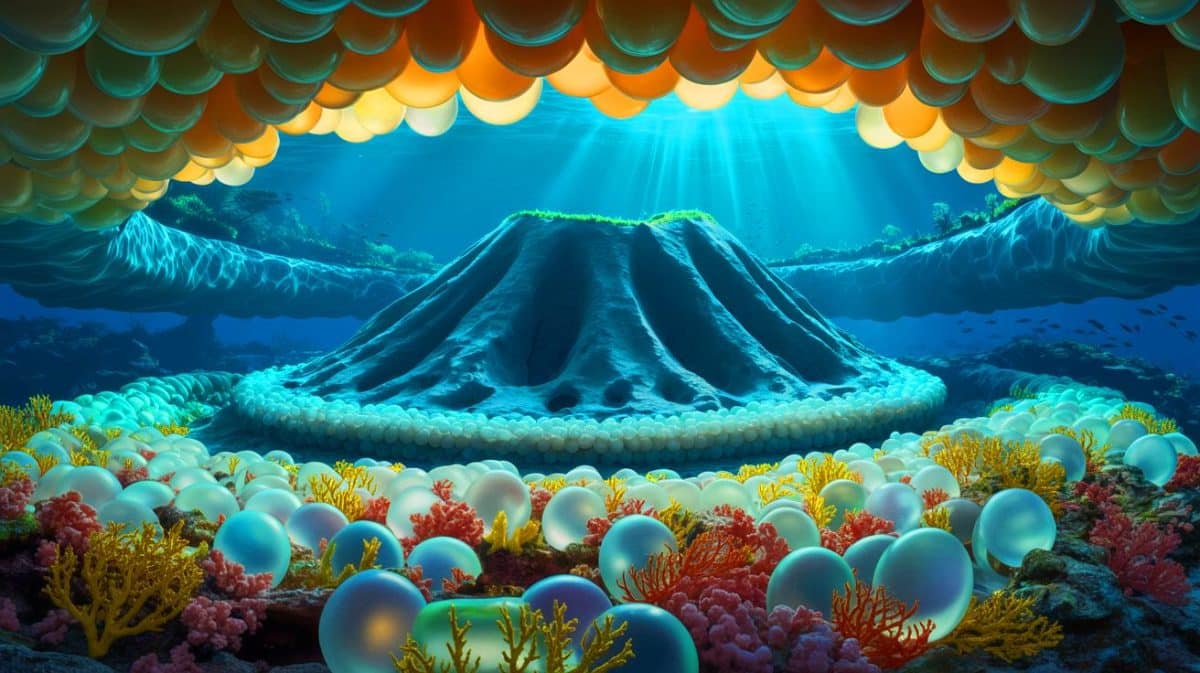
Beneath the calm waters off Vancouver Island, an underwater volcano thought to be long extinct has stunned scientists by revealing an extraordinary secret — a hidden deep-sea nursery containing what could be over a million giant eggs. The discovery has not only left marine biologists astonished but also challenged existing ideas about how life thrives in the ocean’s most extreme environments.
A volcano that refused to die
In 2019, a team from Fisheries and Oceans Canada set out to survey a massive seamount rising more than 3,600 feet above the seafloor. It was believed to be dormant — until sensors detected mineral-rich, hot water venting from its summit. This active heat source had created an unlikely oasis, sustaining deep-sea corals, sponges, and other marine life in a place where survival is normally a struggle.
Then came the true shock: researchers spotted white skate rays (Bathyraja spinosissima) depositing eggs in staggering numbers across the summit — nearly a mile beneath the surface. What was once thought to be a geological relic was now a thriving biological hotspot.
An egg deposit like nothing seen before
Deep-sea skates are no strangers to marine science, but this sheer scale of reproduction was unprecedented. Early surveys suggest hundreds of thousands — possibly over a million — egg cases scattered across the volcanic terrain. Each case, nearly 20 inches long, resembles a soft, pillow-like capsule, designed to protect an embryo in one of the most inhospitable environments on Earth.
This energy-intensive strategy ensures every developing ray has enough nutrients to survive years in the deep, cold waters before hatching — a testament to the species’ incredible adaptation.
Volcanic warmth: nature’s perfect incubator
White skate rays usually inhabit depths of 2,600 to 9,500 feet, making them difficult to study. Now, scientists believe these rays intentionally choose volcanically active areas to speed up embryo development. In normal deep-sea conditions, incubation can last up to four years, but the volcano’s geothermal heat may cut that time significantly.
Marine biologist Cherisse Du Preez notes that the site also offers relatively sheltered terrain, giving hatchlings a safer start before they move into the open depths. This unique use of Earth’s geothermal energy shows how geology and biology can work hand in hand in the most unexpected ways.
A living laboratory in the deep
Much like the hydrothermal vent ecosystems discovered near the Galápagos, this volcanic nursery proves that life can flourish in the harshest conditions. The fact that these rays evolved to lay larger eggs in warm volcanic zones suggests a sophisticated survival strategy that may have been happening unseen for centuries.
And this is just the beginning — scientists believe many more species could be living here, each with its own story of adaptation and survival.
Why this discovery matters
This find isn’t just about one volcano or one species. It’s a wake-up call for the protection of deep-sea ecosystems, which are increasingly threatened by deep-sea mining and climate change. These habitats are fragile and irreplaceable, and each new discovery is a reminder of how little we truly know about our oceans.
As we push further into the unexplored depths, one question lingers: if a million eggs can hide in plain sight on a “dead” volcano, what other wonders are waiting in the dark?
Similar Posts
- 325-million-year-old giants revealed: inside the exceptional discovery of two prehistoric sharks
- A mysterious bacteria has emerged aboard China’s space station—are astronauts in danger?
- 3 Amazing Films That Will Make You Fall in Love with the Oceans Even More!
- Dems Champion Offshore Drilling Ban on Earth Day: A Permanent End!
- 890 people tested: eggs boost memory in women and brain health in men

A passionate journalist, Iris Lennox covers social and cultural news across the U.S.