
Released at the dawn of the 1980s, both brutal and prophetic, “Blood on the Thames” stands as one of the greatest British crime films ever made. In it, Bob Hoskins delivers nothing less than the performance of his career as a crime lord.
Who lit the fuse that would blow up Harold Shand’s empire? Harold, an ambitious gangster from the London underworld seeking legitimacy, attempts to partner with Charlie, a corrupt American businessman.
While rolling out the red carpet for him with the help of his attractive partner Victoria, a series of murders and bombings weakens him, jeopardizing the dock development project he is trying to set up. Who would dare to target him and threaten to shatter his empire? The hunt for the culprit begins…
“It’s the tail end of the great British crime films of the 70s”
Also known by its original title “The Long Good Friday,” directed by John McKenzie, Racket is a pinnacle of the genre. “It’s the tail end of the great British crime films of the 70s, following the likes of Get Carter, Performance, The Deadly Affair, and Sweeney!” explains critic and filmmaker Jean-Baptiste Thoret, in an engaging commentary included in the stunning 4k edition of the film released in December 2025.
“One of the film’s great strengths is its pace, its dynamism, its documentary approach, at a time when London was increasingly gentrifying in the late 70s and early 80s. It also anticipates what Margaret Thatcher’s future tenure would be like, who had just been appointed when the film was shot.”
The origin of this masterpiece of crime cinema comes from the pen of former journalist turned playwright and screenwriter, Barry Keeffe, who knew his subject well. He had covered crime related to the underworld for years for the Stratford Express newspaper.
“I was 18 years old and my editor sent me one day to ask a few questions to a guy in the hospital. I indeed found the guy, covered in bandages and compresses. He had been beaten and nailed by his hands to a floor” he shares. He would later discover that the man had been the victim of a punishment used in the underworld; specifically, a genuine crucifixion on the wooden floor of a warehouse. A scene that is featured in Blood on the Thames…
Keeffe also encountered the feared and ruthless Ronnie Kray, who ruled the underworld with his twin brother Reggie during the Swinging London of the 60s. He, and many other underworld figures he met, would provide material for his future film script.
“When I started to seriously think about the screenplay, I was living in the Greenwich area facing the London docks, the old docks and their extension. I could see them clearly from my office window. The following Sunday, driving my car, I roamed them to discover they were promised a vast rehabilitation, with gorgeous buildings for the upper classes. It really angered me, and prompted me to start writing Blood on the Thames.”
He drafted a first version of the script in just four days, “during an Easter weekend that promised to be deadly dull.” The story was initially titled The Paddy Factor; a derogatory term used since the early 70s by British security forces to denote a modus operandi of fighting against the IRA. But Keeffe already had his main character: Harold Shand, a crime lord in the London underworld whose empire’s foundations are shaken by the IRA fighters.
“Bob is instinctive, everything comes from his gut”
John Mackenzie, a former assistant to Ken Loach who had directed his first feature in 1970, One Brief Summer, took the helm of the film, entrusted by producer Barry Hanson. “We had worked together on television, he knew that I, like him, passionately loved gangster films, especially those starring Humphrey Bogart and James Cagney,” explained the director.
Mackenzie extensively reworked Keeffe’s original script, particularly the tone of the film, the entire opening, and especially made sure to reveal much later the identity of those attacking Harold Shand’s crime empire.
Shand is portrayed by Bob Hoskins. Not yet an international star, he delivers here a terrifying mix of cold brutality and barely contained rage before exploding into an extraordinary performance that even stunned the director: “Bob is instinctive, everything comes from his gut.”
If the film rests on his broad shoulders, and also partly on those of the sensational Helen Mirren whose role depth owes her a lot, Bob Hoskins is entirely devoted to his character. “I saw myself in this guy, not because I dreamed of being a gangster, but because I shared the same energy, the same vitality.”
To enrich the material for his future portrayal, Bob Hoskins would hang around the rough neighborhood of Finsbury Park, where he grew up. “I knew a few criminals from childhood, and I hung out with several tough guys to familiarize with their ways. They were amused and flattered that an actor wanted to resemble them. They were absolutely charming with me. The criminal world loves show business.”
“I was desperately trying to come off as a credible gangster”
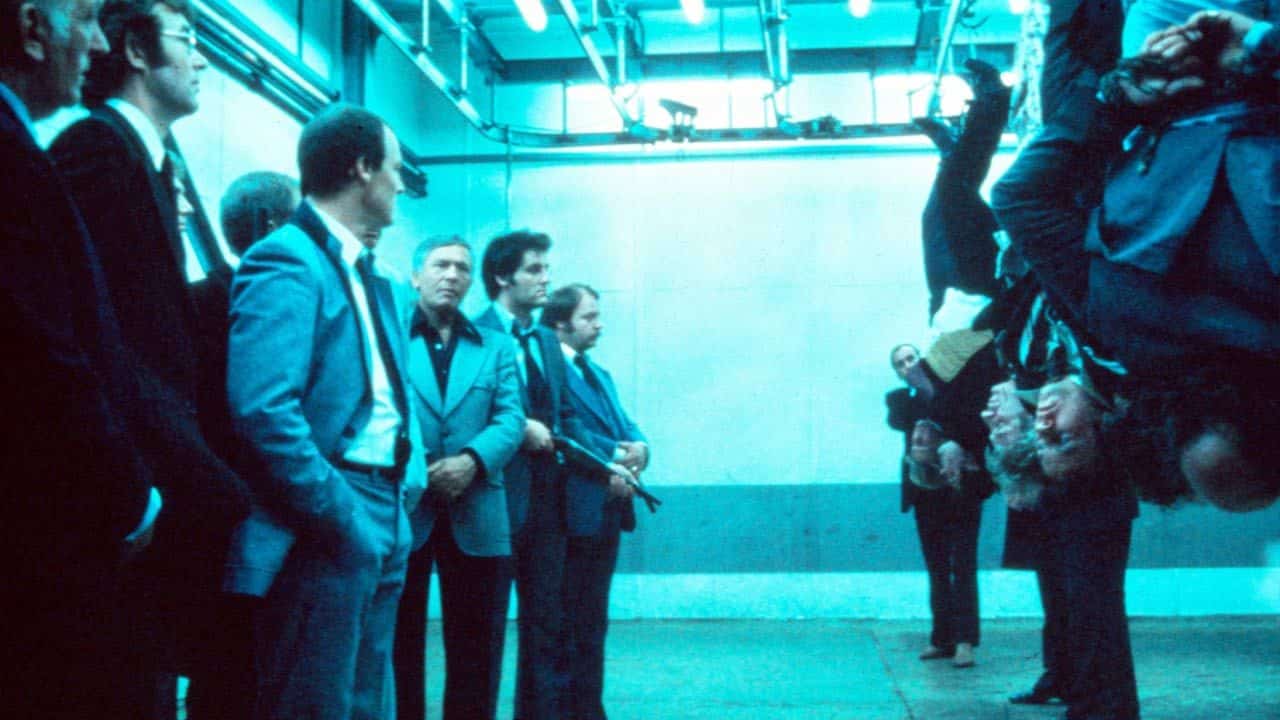
There were even authentic criminals on the set of the film, recruited among Barrie Keeffe’s acquaintances for extras, particularly in the scene where Shand hands out weapons with instructions to find and interrogate those who might know something about the attacks he is suffering from. Or in the extraordinary scene of the abattoir interrogation, where suspects are hung from butcher hooks, upside down.
Some of them did not hesitate to offer some advice to Hoskins. “At the beginning of the shooting, I tended to overact, to bustle to show that I was the boss, the leader. I was desperately trying to come off as a credible gangster,” recounted the actor.
“After a take, a guy took me aside. ‘You don’t need to move like that, to shout,’ he told me. ‘All these guys around know who Harold Shand is and he knows that they know. What’s the point of raising your voice under these circumstances?’ Simple and effective advice. From then on, I chose to express things as women do: let my face reflect my thoughts, my intentions. Introspect.”
“We had a terrible battle with those damn bastards”
Shot in eight weeks on a budget of just $1.5 million, Blood on the Thames was in grave peril: the film could not find a distributor in Great Britain, even though it toured several festivals where it was enthusiastically received.
To make matters worse, a certain Jack Gill, the #2 at the parent company of Black Lion, which produced the film, panicked over the touchy subject of the IRA in a particularly heavy political context. The firm feared that the film might make the organization, which was then fighting a deadly battle against the British crown, appear too sympathetic and might start bombing movie theaters.
Jack Gill then considered releasing the film directly on television. When he discovered this possibility, which also involved trimming the film’s length by more than 20 minutes, the director was horrified and complained to producer Barry Hanson: “I told Barry he couldn’t let this happen. He replied: ‘I can’t act, I’m not the boss. The film doesn’t belong to me. Anyway, it’s done.’ […] I was about to hit him.” Blood on the Thames indeed already had a TV broadcast date scheduled: March 24, 1981.
The entire film crew, both technicians and actors, sounded the alarm and mobilized to change the film’s doomed trajectory. Hoskins even had the unpleasant surprise of finding out that the producer had hired someone behind his back to dub him vocally in the American version of the film, to make him more intelligible, and sued Black Lion and the American broadcaster. With all this bad publicity, Jack Gill eventually backpedaled. “We had a terrible battle with those damn bastards,” John McKenzie would say, summarizing this epic showdown.
The film was finally purchased and distributed by Handmade Films, a company co-founded by former Beatles George Harrison. Released in full version in British cinemas on March 29, 1981 and in the United States in April of the following year, it was very well received. And in France? It arrived quite late in an atmosphere of polite indifference, in October 1983. Shown confidentially on a handful of screens, its theatrical run was logically a disaster: barely 14,000 spectators…
Time has fortunately done its work, elevating Blood on the Thames to the status of a major work in the genre, and of English cinema as a whole. Judging by the very low number of notes on its record (barely 121…), there is still a lot of work to be done to evangelize the masses around this extraordinary crime film, still too little known by many viewers.
AlloCiné, it’s every day more than 40 articles about the news of cinema and series, interviews, streaming recommendations, unusual and cinephile anecdotes about your favorite films and series. Subscribing to AlloCiné on Google Discover, it’s the assurance of exploring every day the riches of a site designed by enthusiasts for enthusiasts.
Similar Posts
- Can You Identify These 7 Iconic Movie Posters? Take the Quiz!
- After 32 Years, Fans Finally Spot This Star in “Groundhog Day”!
- Taylor Sheridan’s Standalone Series Returns for Season 4 – Not in Yellowstone Universe!
- Sylvester Stallone Wasn’t the First Rambo on Screen! Discover Who Was
- Before Stallone: The Forgotten Actor Who Played Rambo First!

A passionate journalist, Iris Lennox covers social and cultural news across the U.S.