
Follow AlloCiné on Google
In anticipation of the release of the live-action version of Disney’s “Moana, the Legend of the End of the World,” we spoke with the director about the major challenges of this adaptation.
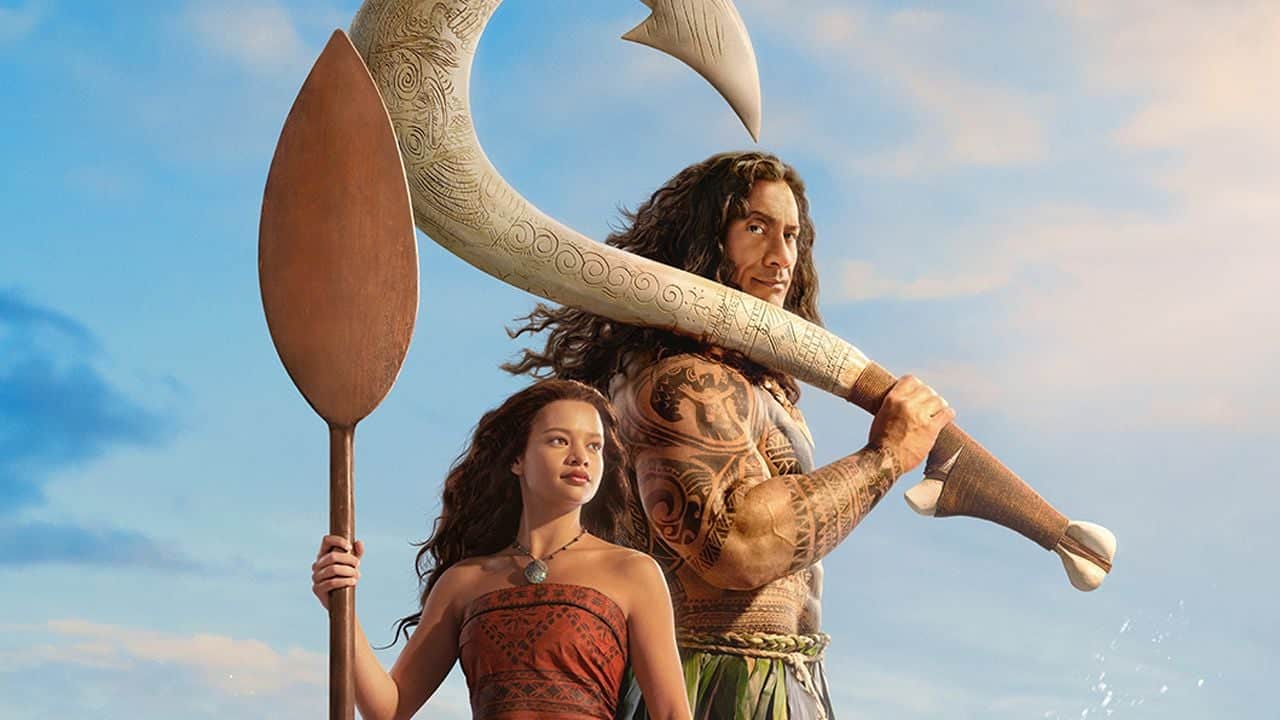
It’s one of the most anticipated films of 2026, hitting theaters on Wednesday, July 8. The live-action adaptation of “Moana, the Legend of the End of the World” is revealed through new images.
While the first teaser allowed us to see the face of Catherine Laga’aia, who portrays the heroine, as well as the universe of the feature film, these new images immerse us deeper into the story of the film. We finally see the face of Maui, played by Dwayne Johnson – who had already lent his voice to the demi-God in the original movie – along with Pua (alias Bacon), Hei Hei, and Moana’s family.
The launch of this event trailer also provided an opportunity to chat with director Thomas Kail.
Already known for his work on adapting the musical “Hamilton” to the screen, and a longtime collaborator of Lin-Manuel Miranda – composer for Moana -, Kail is a huge fan of the original film by John Musker and Ron Clements. He has therefore ensured to respect the original work as much as possible, preserving key story elements, the character’s spirit, and iconic moments, while introducing new visual and narrative elements. He describes this new version as “a complementary work” that enriches the universe of Moana without denaturing it. Here’s our conversation.
AlloCiné: Adapting a film as beloved and recent as Moana into a live-action version is risky. What was your first reaction when you were offered the project?
Thomas Kail: I saw it as a unique opportunity to create something that could stand as a complementary work. You know, I love the 2016 movie just as much as the millions of viewers who discovered it. And I was really excited by the challenge of bringing it to life in a new form. Of course, revisiting a work that has only been out for ten years, many people will watch it with very recent memories in mind.
But in my opinion, Moana isn’t a movie that you watch once and forget ten years later. Most viewers have probably rewatched it recently, maybe even on their way to the cinema… So it remains very much alive in our lives. And obviously, with the success of Moana 2, it felt like there was a desire from the audience to spend even more time with these characters. It was a very exciting project for us, and we were fully aware of it during the film’s production.
AlloCiné: You speak of a complementary work. How do you manage to stand out while staying true to the original? Can the audience expect any novelties?
Thomas Kail: You know, we wanted to trust what works. And what works is the story of the film, its unforgettable characters, and so many of those iconic moments. I think that, by the very nature of transitioning to flesh-and-blood human beings, the experience of watching and feeling the film becomes intrinsically, chemically, and fundamentally different.
So, we decided to trust all these existing strengths, while also not being afraid to revisit a scene or propose an interpretation that feels fresh and right for our world. Our film was written by Dana Ledoux Miller (Co-Director of Moana 2) and Jared Bush (co-director of the first installment), so they have a deep connection with the original Moana. We felt like the DNA of the film was coming from people who were there from the beginning. They provided us with an excellent blueprint, and we built the edifice from there.
AlloCiné: What was the biggest challenge you faced while making this film?
Thomas Kail: I’d say that when you’re making a film with so many elements to coordinate, the only way to succeed is to assemble a true “dream team”. Everyone has to be the best in their field. Making a movie is a deeply collaborative effort: it’s a relay race where you pass the baton several times a day, and from the start of shooting to the end of post-production, some people work on the film without even knowing those who were there at the beginning.
For me, the challenge was… having done a lot of theater, many skills were immediately transferable: working with actors, telling a story, staging a musical number. But I had never done it in 40-degree heat, nor on water. Working on water – whether at sea or in a tank – was a whole new challenge.
I also wondered how to try to make something as honest as possible while many elements will be created later in post-production. In a way, it’s very related to the work of theater and imagination: you have to imagine what is around you. Sometimes it’s simple because you’re in the middle of the village, and sometimes you’re fighting a lava monster. It really depended on the days.
AlloCiné: The sets, especially the village, were built physically. Why was it important for you to prefer real sets over a digital environment?
Thomas Kail Well, the village is our anchor element of the film, because it’s precisely what Moana is trying to save. These are the people she sets out to help on this adventure, trying to preserve not only her community but the entire island.
For the entire first part of the story, which takes place in the village, there was something very special about building these fales – these traditional houses – and bringing together nearly 200 actors. It gives the film a very concrete prism, which then allows access to more fantastic elements while remaining grounded in reality.
So, when you see real sweat, real dirt, real grass – real, simply – then, when a lava monster or a 30-meter singing crab appears… – which doesn’t exist, I’m sorry to inform you (laughs) – you feel like you’re coming from a tangible world. And because you’ve first got your feet on the ground, you can then reach for something much bigger.
AlloCiné: Dwayne Johnson is back, and it’s quite amusing to see him with long hair! What was his level of involvement in the project, knowing that this is a film close to his heart and that he is a producer?
Thomas Kail: At every level. From the very first days – and even just yesterday, when we were texting about a detail in the trailer. He has been fundamentally involved throughout the process, as a producer and of course in front of the camera.
He has brought true leadership. He and Catherine have developed that complicity that you always hope to find. You know, the film rests entirely on the two of them: they are the ones who set out together to try to save the world. Their chemistry, their dynamic, that spark… it’s exactly what you look for during casting.
As soon as I discovered Catherine – first through a filmed audition, then on Zoom, then in person – I felt it immediately. And the day she walked into the room in New York for her final audition, I knew she could stand up to Dwayne. And that’s no small feat! Their duo works wonderfully, and I think that set the tone for the rest of the film.
When I met Catherine, it was obvious.
AlloCiné: Catherine Laga’aia really looks like Moana. How did you discover her?
Thomas Kail: Our team searched all over the world. And the reality of casting – after 25 years of doing it, even though I still look young – is that you know immediately when someone is the right choice.
Nowadays, it sometimes starts with a screen. But when I met Catherine in person, there was something obvious. A special energy. A fearlessness, a determination, a joy… everything that defines Moana. She naturally had that fire. And then, we said, “That’s her.”
AlloCiné: Did she work with Auliʻi Cravalho – who voiced Moana in the animated films – to perpetuate the legacy of the character?
Thomas Kail : Absolutely. Auliʻi is an executive producer on the film and she has been very involved. I was there during their first meeting, and… they share something that no one else can really understand: what it means to be Moana.
The connection was immediate. It was really beautiful to witness. I’m thrilled that they can now carry this adventure together.
AlloCiné: What did you feel the first time you saw Dwayne Johnson as Maui and Catherine as Moana, in costume on the set?
Thomas Kail : I thought I had the best job in the world. Honestly, I couldn’t believe I was lucky enough to experience that.
This is a film that means a lot to me, and I just hope we can deliver something as entertaining and enchanting as possible to families around the world.
AlloCiné : You’re working again with Lin-Manuel Miranda, your longtime partner. How have you revisited the iconic songs for this version, and what role does music play in the film?
Thomas Kail : Music is the beating heart of the film. It’s one of the reasons why it remains so present in our lives. You can watch the film, of course, but the songs, they follow us everywhere. They stay in your head, in your ears, in your heart.
Music is the beating heart of the film. It’s a responsibility.
I remember a very strong moment: we were sitting in the village, with Lin and Alex Lacamoire, with whom we worked on Hamilton and In the Heights. We were watching the troupe perform a song written by Lin with his collaborators, Mark and Opetaia.
We looked at each other… We’ve been working together since the early 2000s, in a small “black box” theater on 40th Street. And there we were, in the heart of Motunui.
I thought it was a moment to savor. And above all, a responsibility: to honor these songs and to offer them anew to the world.
Moana, the Legend of the End of the World is expected in our theaters on July 8, 2026.
AlloCiné, it’s daily more than 40 articles dealing with the news of cinema and series, interviews, streaming recommendations, unusual and cinephile anecdotes about your favorite films and series. Subscribing to AlloCiné on Google Discover, is the assurance of exploring daily the riches of a site designed by enthusiasts for enthusiasts.
Similar Posts
- Ace This Dwayne Johnson Movie Quiz or You’re Not a True Fan!
- Is a Moana 3 Coming? Disney Sequel Plans Revealed!
- Martin Scorsese Taps Fast and Furious Star for New Thriller!
- Must-See Kids’ Movies in July 2026: Vaiana, Spider-Man 4, The Girl in the Clouds!
- $1.7 Billion Box Office Hit: Cult Adventure Saga Returns After 7 Years!
A passionate journalist, Iris Lennox covers social and cultural news across the U.S.