
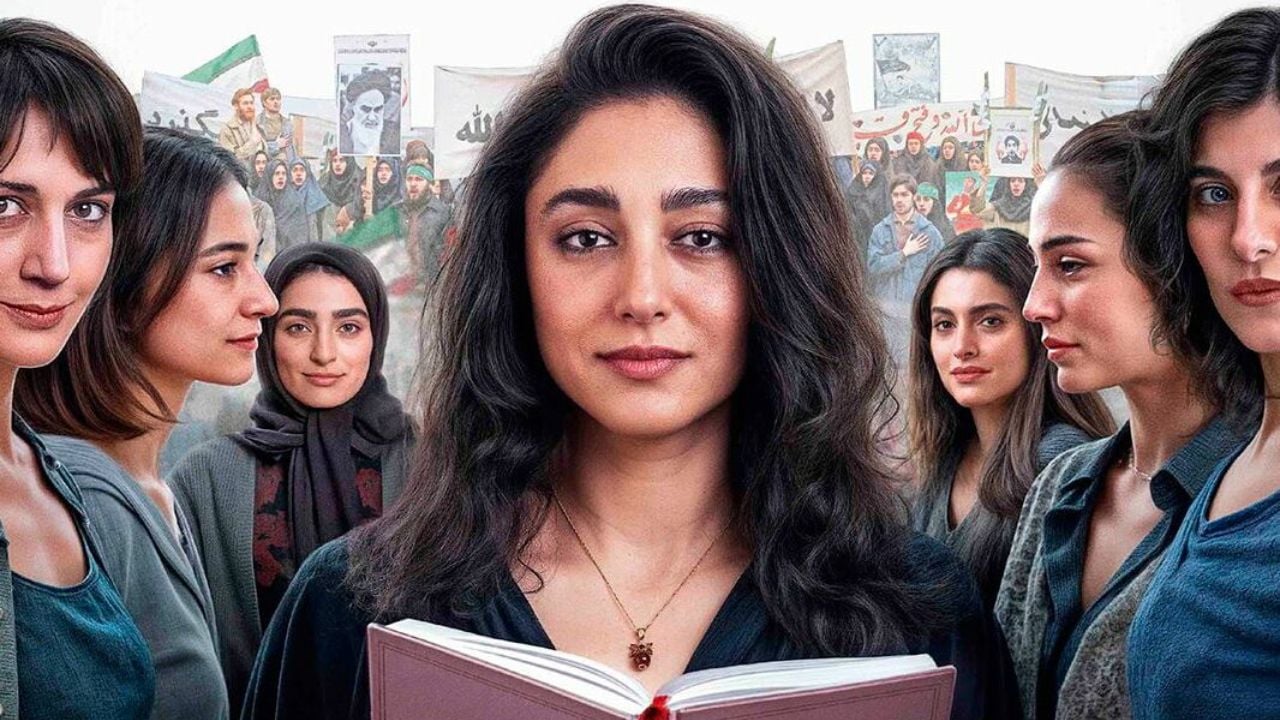
Directed by Eran Riklis, “Reading Lolita in Tehran” is a film adaptation of Azar Nafisi’s bestselling novel, which has sold over a million copies worldwide. The film features Iranian actresses who have fled their homeland. Here’s an insight.
“Reading Lolita in Tehran” transcends borders: featuring Iranian actresses, directed by an Israeli, and filmed in Rome, Italy. For Mina Kavani, who portrays Nassrin, this is ultimate proof that “art is meant to bring us together,” which is also a central theme of the film.
Published in 2003 by Azar Nafisi, Reading Lolita in Tehran has become a global phenomenon. Translated into 32 languages, it has remained on the New York Times bestseller list for over 100 weeks.
The story is inspired by the life of its author, an English professor at the University of Tehran during the early days of the Iranian Revolution, portrayed in the film by Golshifteh Farahani. In protest against the oppressive regime and its restrictive laws, she starts a book club where women gather to discuss Western literature accused of corrupting the nation’s morals.
The film adaptation, directed by Eran Riklis, brings together Iranian actresses with diverse backgrounds who share exile as a common thread. As a political statement, “Reading Lolita in Tehran” highlights the ongoing struggle for personal freedom.
AlloCiné: The film begins in 1979, at the start of the Iranian Revolution, and spans several decades up to 2003, the year the book was published. Why do you think “Reading Lolita in Tehran” resonates even more in today’s society?
Golshifteh Farahani: Today, world leaders are erecting walls and increasingly dividing citizens. Art and culture are major targets because they unite and inspire people. They bring hope and remind us that we are all just human beings. That’s why books are burned in totalitarian regimes. This is the power of a film like “Reading Lolita in Tehran.”
When we fight for women in Iran, we are fighting for women everywhere.
The film primarily features female characters, and all of you share the experience of exile. It’s impossible for you to return to Iran without facing sanctions and imprisonment. How was it to find yourselves together in this project?
Mina Kavani: This is the first time we’ve acted together. Most of my scenes are with Golshifteh, and I must say, I knew her when I was little in Tehran. She was already a star in Iran then, so we’ve known each other a long time. She was friends with my older sister.
Acting with her was symbolic because, although our paths are different, we found ourselves in the same situation with the same zest for life. And here, we were together on a film set that tells our stories. It was overwhelming.
Often, when discussing the struggle for women’s rights, in Iran as well as in France, the focus is mainly on the female citizens, but this struggle also concerns men. If women’s rights are at risk, all rights are at risk, regardless of gender.
Golshifteh Farahani: When we fight for women in Iran, we fight for all women, for all genders, for humanity, justice, equality. These are human values. And it’s not just a geographical issue either. When COVID appeared, it didn’t choose which countries to spread in. Everyone was affected.
Mina Kavani: Especially since we come from a country where many men fight hard for women. I remember during the Woman Life Freedom movement, nobody talked about this. There were many men who were imprisoned, killed, massacred because they fought for women.
There’s inevitably a sense of loneliness associated with exile…
Golshifteh Farahani: I believe all human beings carry a sense of loneliness within them. However, exile intensifies it. The beauty, if I may say, of this exile is being able to articulate this feeling with those who experience it.
We live in France, and I must say that this country has done a lot for Iranian women and for Iran, culturally speaking. We are grateful for that. There are many artists who need to leave, and it is France that provides visas for them to find another chance, especially when their lives are in danger.
The story is set in Tehran, Iran, but the entire film was shot in Rome, Italy.
Mina Kavani: Yes, because it’s simply forbidden to film in Iran, to act without a veil, to tell the reality from there. There’s a level of censorship that prevents artists from expressing themselves. The only films made in Iran are done so secretly. It’s a huge risk. Many have been caught and could not finish their films.
The closing credits feature a song, “Baraye,” by Shervin Hajipour. This song became an anthem during the citizen uprising against the mullahs’ regime in 2022. The singer was initially sentenced to three years and eight months in prison for “propaganda.” He was later released a few months afterwards.
Golshifteh Farahani: The artist, Shervin Hajipour, asked people to write on Twitter all the reasons they were revolting. He then used all the tweets to create a song. When the band Coldplay performed this song at their concert [Golshifteh Farahani performed the song with the band on stage in 2022, ndlr], it was significant because it gave an international resonance to the movement.
The story of Shervin Hajipour mirrors that of “Reading Lolita in Tehran.” We gather in secret because literature keeps us alive. Shervin was imprisoned because he is a threat to the regime. A regime with so many weapons, drones, money, yet they fear a simple song.
“Reading Lolita in Tehran,” now playing in theaters
Similar Posts
- Scarlett Johansson and Kristen Stewart Win Big at Deauville 2025; ‘The Plague’ Takes Top Prize!
- Over 80 Groups Urge Biden: Say No to War with Iran!
- DOJ Unveils Murder Plot Charges, Rising Fears Over Trump’s Iran Policy
- Pentagon Deploys US Troops to Israel, Sparks Major Concerns
- Planet B: Adèle Exarchopoulos, Souheila Yacoub Star as Eco-Warriors in Year’s Most Surprising Sci-Fi Film!
A passionate journalist, Iris Lennox covers social and cultural news across the U.S.