
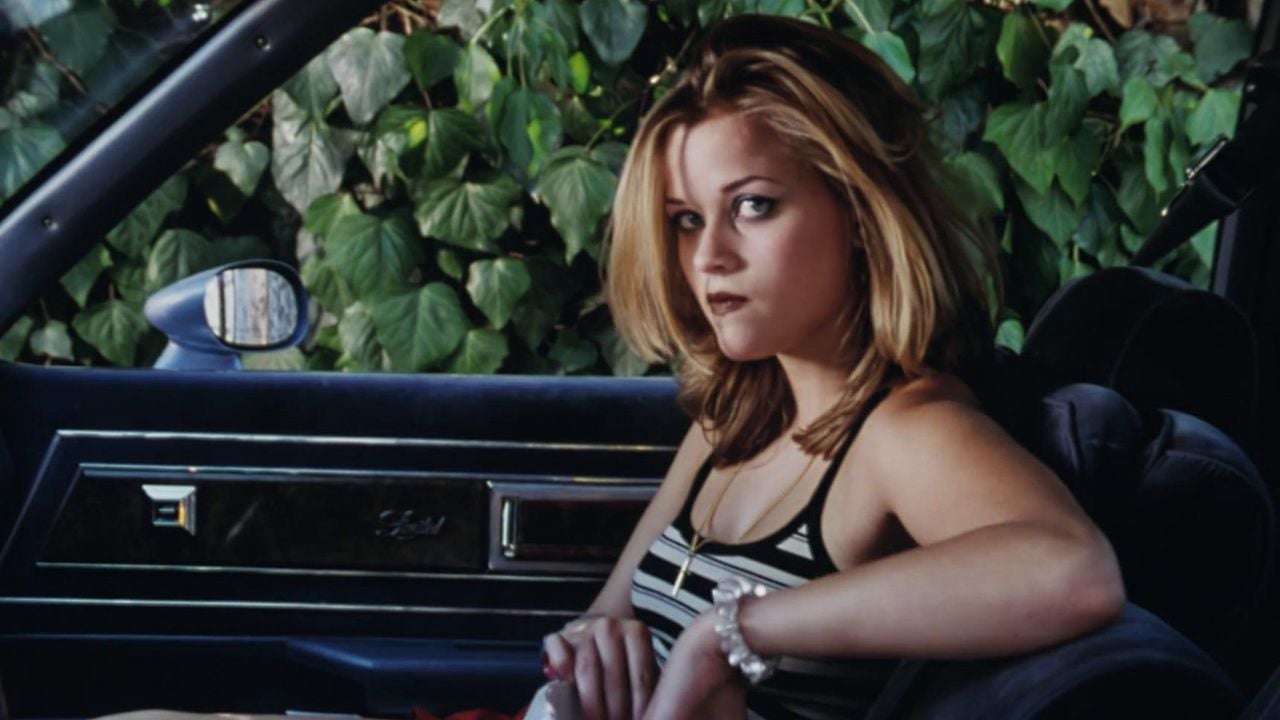
Despite flying under the radar in 1997 and being a box office flop, “Freeway” was an edgy, gritty, and violent reinterpretation of the classic tale of Little Red Riding Hood, featuring one of Reese Witherspoon’s standout performances.
Before becoming a household name with “Pleasantville” and continuing her rise with “Cruel Intentions,” the comedy “Legally Blonde,” and her Oscar-winning role in the Johnny Cash biopic “Walk The Line,” Reese Witherspoon truly shone in the fierce gem that was “Freeway,” released in 1997.
The story? With a mother who turns to prostitution to support her crack habit and a stepfather who molests her, Vanessa Lutz (Reese Witherspoon) is far from living a fairy tale. After her parents are arrested, and to avoid being placed in foster care again, she decides to visit her grandmother who lives in a trailer hundreds of miles away, much like Little Red Riding Hood. Along the way, she encounters Bob Wolverton, a child psychologist by day and a monstrous “Big Bad Wolf” by night—a serial killer, necrophile, and pedophile. Quite the resume…
“Back then, I was a struggling screenwriter and a weed dealer”
The film’s twisted, raw, and fierce take on the famous fairy tale is credited to director Matthew Bright. Unfortunately, he has largely faded into obscurity since then.
“Back then, I was a struggling screenwriter and a weed dealer,” the director reveals in a compelling 2022 video interview titled “Vulgarity is Timeless,” a name that perfectly encapsulates his unfiltered and brutally honest nature.
“I had to write to make a living. I started writing without a clear direction. I needed a plot. And I thought: ‘Little Red Riding Hood, that’s a simple story. It can take me from point A to B to Z, allowing me to focus on the characters. Oliver Stone read my script, loved it, and said it needed a bankable star.”
“She didn’t even have to try, she was that talented”
The producers then created a list of twenty potential stars, including John Travolta. “He hadn’t done ‘Pulp Fiction’ yet and was in a slump. Kiefer Sutherland was the last one we contacted before they took the project away from me. Actually, Oliver was supposed to direct the film; it would have been a cool movie with a bigger budget,” Bright shares.
Producer Samuel Hadida, founder of Metropolitan FilmExport (who passed away in 2018), slightly moderates Bright’s statements: “Stone had read several of Matthew Bright’s scripts and wanted to support this film. He did not want to direct it but to keep it a low-budget project, which was around 3 million dollars. We thought the script was trendy, crazy. And the only way to make this film was to say that his talents also endorsed it. It was thanks to Kiefer Sutherland’s involvement that the film could exist.”
A good choice indeed: Sutherland delivers a brilliant performance as a psychopathic wolf in sheep’s clothing, luring his victims. While the Big Bad Wolf traditionally has big teeth, Vanessa Lutz is, of course, set to file them down…
Having started her film career in 1991, Reese Witherspoon explodes onto the screen as Vanessa Lutz; a fearless, ingenious character who masterfully controls her grim fate. “When she came in, she got the role in less than three seconds. She didn’t even have to try, she was that talented,” says Matthew Bright, full of genuine admiration for his actress who displays incredible vitality and energy on screen. “Reese Witherspoon reminded me of Juliette Lewis in ‘Natural Born Killers,’ she’s absolutely fantastic,” comments Oliver Stone, the executive producer of the film, in a 2010 interview about the film.
A symbolic dollar as salary for Tim Burton’s favorite composer
Due to a tight budget, the film was shot guerrilla-style in just three weeks. “If I had more budget, I would have taken 30 or 40 days. But I couldn’t, so it was exhausting,” Bright recounts. Despite the constraints, the film managed to attract talents like Amanda Plummer, Brooke Shields, the late Brittany Murphy, veteran character actor Dan Hedaya; Michael T. Weiss, who filmed this movie between seasons of his series “The Pretender,” and portrayed Reese Witherspoon’s incestuous and drug-addicted stepfather. Also involved was editor Maysie Hoy, a friend of Oliver Stone, who had previously edited films such as Robert Altman’s “The Player.”
Even a legendary film score composer, Danny Elfman, came on board. A childhood friend of the filmmaker, and already a Hollywood luminary by the time “Freeway” was released for his unforgettable scores for Tim Burton, Elfman agreed to compose the score for “Freeway” for a symbolic dollar… Along with a tasty favor: Matthew Bright and producer Brad Wyman agreed to do a week’s worth of yard work at Elfman’s large property. Yes, you read that correctly.
“The guy hated the film to a degree I can’t even explain”
Unfortunately, “Freeway” was a colossal flop at the box office. However, before the harsh economic reality set in, Bright’s film was screened at the prestigious Sundance Film Festival in January 1996. “The first review of the film was terrible,” Bright remembers. “The person who was supposed to review it couldn’t come due to a snowstorm, so they sent someone else. The guy hated the film to a degree I can’t even explain. And then a year later, he wrote an apology, he hadn’t gotten it at the time, hadn’t understood. He found the film horrifically violent, and gratuitously so. He was offended by the social class of the people depicted, the ‘White Trash,’ who are rarely represented on screen. I gave them dignity, but I also let them unleash themselves… I was depressed, afraid people would think the same, that my film was a comedy about pedophilia.”
Nevertheless, the director was somewhat reassured—albeit very temporarily—by subsequent reviews, which generally praised the film’s boldness. However, this did not prevent the film from crashing at the box office. During its opening weekend in the United States, in August 1996, “Freeway” earned less than $15,000 and finished its theatrical run with less than $300,000 in revenue.
“Matthew didn’t look like a typical director, he was different,” recalls Oliver Stone. “The only problem we really had was between the producers and him. Matthew doesn’t collaborate well and struggles to make himself understood. He’s too shy, sometimes adopts a passive-aggressive behavior. With Danny Halstead, we tried to smooth things over. I fought for Matthew, the film was released. While it got noticed by critics, it didn’t bring in any money.”
“Freeway” and “Natural Born Killers,” cut from the same cloth
While it is extremely violent (and rightly earned its R rating), “Freeway” offers a fierce critique of the underside of the American dream and the violence of its society. Oliver Stone remarks that Bright’s work shares the same mold as his own incendiary film “Natural Born Killers,” released three years earlier. “It shows the system as it is: a sick and ugly world where crime is institutionalized because it enriches many people. Prison has become an industry. While the poor must fight, killers are set free. Here, they are well-to-do bourgeois.”
“Freeway” and “Natural Born Killers” ultimately received the same reception: apparently, it’s too satirical. Satire doesn’t work in the United States. Hypocrisy and anti-sexuality have come back in force. The freedoms we took for granted in the 60s and 70s have today disappeared,” comments Stone, whose words once again reflect the mark of a filmmaker known for his commitment.
Matthew Bright, for his part, emerged drained from the experience. Two years later, he directed “Freeway 2,” a largely forgotten and unofficial sequel released directly to video, which also provided a trashy take on the Hansel & Gretel tale. After two TV movies and two films, nothing more.
“At one point, they played my film on loop on cable TV channels, and then it vanished. Because it’s quite bleak. You don’t want to see actors living through hell,” explains Bright, who holds no illusions about his chances of returning behind the camera after a 24-year silence. Now 74 years old, he may simply no longer have the desire. Or the energy.
Thus remains his fierce gem, “Freeway,” one of the best films of the 90s. Until recently available only in an outdated DVD edition, it has fortunately just been released in a stunning 4K edition. If you’ve never seen this little jewel, now you know what to do.
Every day, AlloCiné offers more than 40 articles on the latest in film and TV, interviews, streaming recommendations, quirky anecdotes and cinephile insights about your favorite movies and TV shows. Subscribing to AlloCiné on Google Discover ensures you explore daily the riches of a site designed by enthusiasts for enthusiasts.
Similar Posts
- Why Quentin Tarantino Refused to Watch This Iconic ’90s Film He Wrote!
- Tonight on Amazon: Oliver Stone’s Misunderstood Masterpiece, Still Powerful After 32 Years!
- First Look: Cult Classic 2000s Comedy Returns as Series After 22 Years – Meet the New Heroine!
- Famous Actress Rejected From Decade’s Best Thriller 12 Years Ago!
- Top 4 Movies Featuring Kevin Costner’s Favorite Co-Star Revealed!

A passionate journalist, Iris Lennox covers social and cultural news across the U.S.