
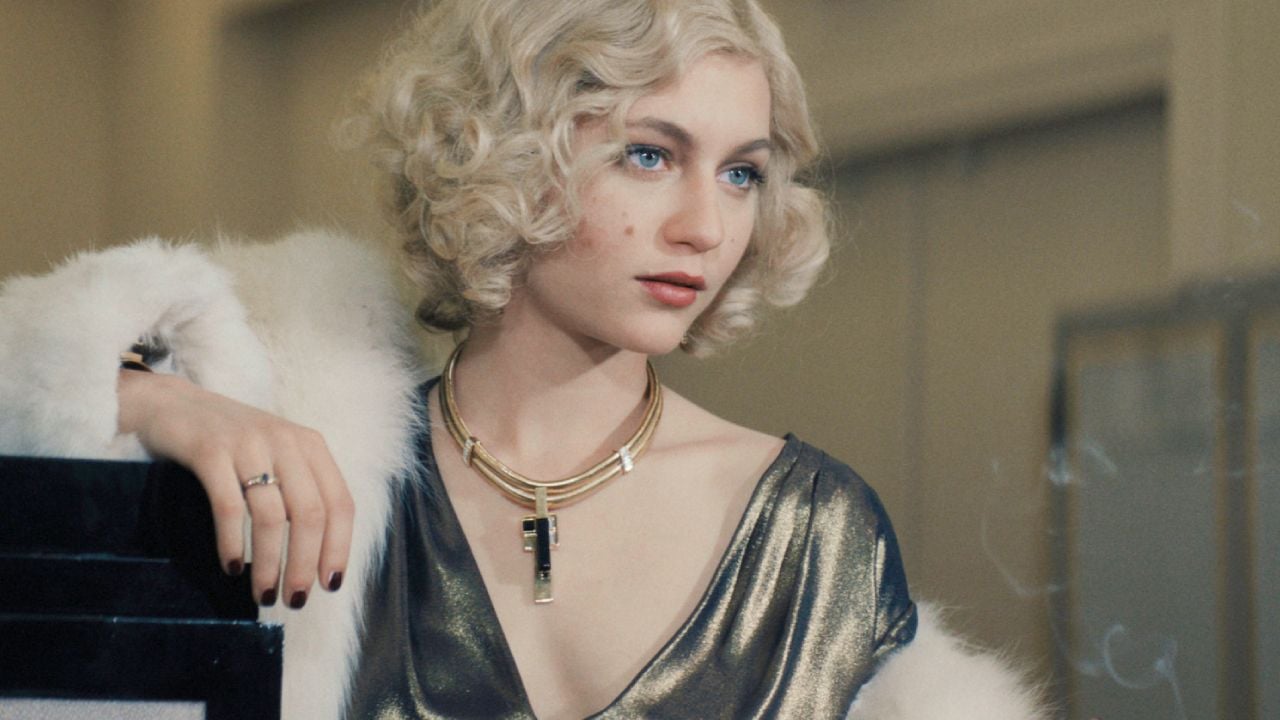
In “Rays and Shadows,” director Xavier Giannoli explores the troubling path of journalist Jean Luchaire towards collaboration with the Nazis and the tragic downfall of his daughter, Corinne Luchaire.
Spanning 3 hours and 20 minutes, “Rays and Shadows” by director Xavier Giannoli delves into the life of Jean Luchaire. This journalist, who established the daily Les Nouveaux Temps, became notorious for his collaboration with Nazi Germany, dragging along his daughter, Corinne Luchaire, a rising star in French cinema.
In the film, the roles of father and daughter are portrayed by Jean Dujardin and Nastya Golubeva, both delivering remarkably authentic performances. The movie chronicles, among other things, the rise and fall of the actress, who died in 1950 at the age of 28 from tuberculosis. Here are five facts that “Rays and Shadows” does not reveal about this woman with a thwarted destiny.
Rosita, “Zizi,” or Corinne
Corinne Luchaire was actually a stage name, chosen for the actress’s first steps in front of the camera under director Léonide Moguy. She was born Rosita Christiane Yvette Luchaire. Her first name was inspired by the rose, “the queen of flowers,” as noted by biographer Carole Wrona. However, from her school days, her classmates called her “Zizi,” a nickname even her mother, Françoise Germaine Besnard, used. The name Corinne Luchaire first appeared in the credits of Prison without Bars in 1938.
A Friend of Simone Signoret
Renowned as one of the greatest actresses in the history of French cinema, Simone Signoret was well-acquainted with Corinne Luchaire. They were classmates as children. Having lost touch, Simone Signoret recognized her old friend on the big screen in Prison without Bars. For a while, Jean Luchaire hired her as a secretary at Les Nouveaux Temps—at the time, she was still known as Simone Kaminker, due to her Jewish heritage.
The magazine Revus & Corrigés even explains that Corinne Luchaire helped Simone Signoret get her first film roles, opening the doors to movie sets for her. Decades later, in 1960, Signoret won the Oscar for Best Actress for the movie Room at the Top.
“The Second Greta Garbo”
Corinne Luchaire’s rising fame in France reached international levels. When Prison without Bars was released in theaters, an English version was produced that same year. Corinne Luchaire reprised her leading role. Global star Mary Pickford referred to her as “the second Greta Garbo.” At the time, Corinne Luchaire was only 17 years old.
An Autobiography Published
In 1949, just a year before her death, Corinne Luchaire published her autobiography, titled My Funny Life, with the assistance of a journalist who collaborated with the Nazis, Jean Thouvenin. The book was heavily criticized for its naive tone, and the former actress struggled to acknowledge her mistakes. She continued to defend her father, whom she described as a martyr.
What Became of Her Daughter?
In Xavier Giannoli’s film, Corinne Luchaire has a young daughter, Brigitte. Born from a relationship with a German officer, Wolrad Gerlach, the child was six years old when her mother passed away. She was subsequently raised by her grandmother, Françoise Luchaire. In a feature dedicated to Corinne Luchaire, Le Monde notes that Brigitte later met a young man and followed him to Canada, where she became a bookstore clerk. Thanks to her marriage, she was able to leave behind her burdensome surname.
Rays and Shadows, now playing in theaters
Similar Posts
- Must-See March Movie Masterpiece Scores 4.2/5 – Unmissable and Stunning!
- Jean Dujardin’s Upcoming Hits: Sci-Fi, Historical Epic, True Story Set for 2025-2026!
- Jean Dujardin Stars in Sci-Fi Cult Classic Remake: Watch the Stunning Trailer Now!
- Can You Identify These 8 Movies? Take the Ultimate Cinema Quiz!
- Jean Dujardin Stars in New True Story Adaptation After Sci-Fi and Epic Historical Films!

A passionate journalist, Iris Lennox covers social and cultural news across the U.S.