
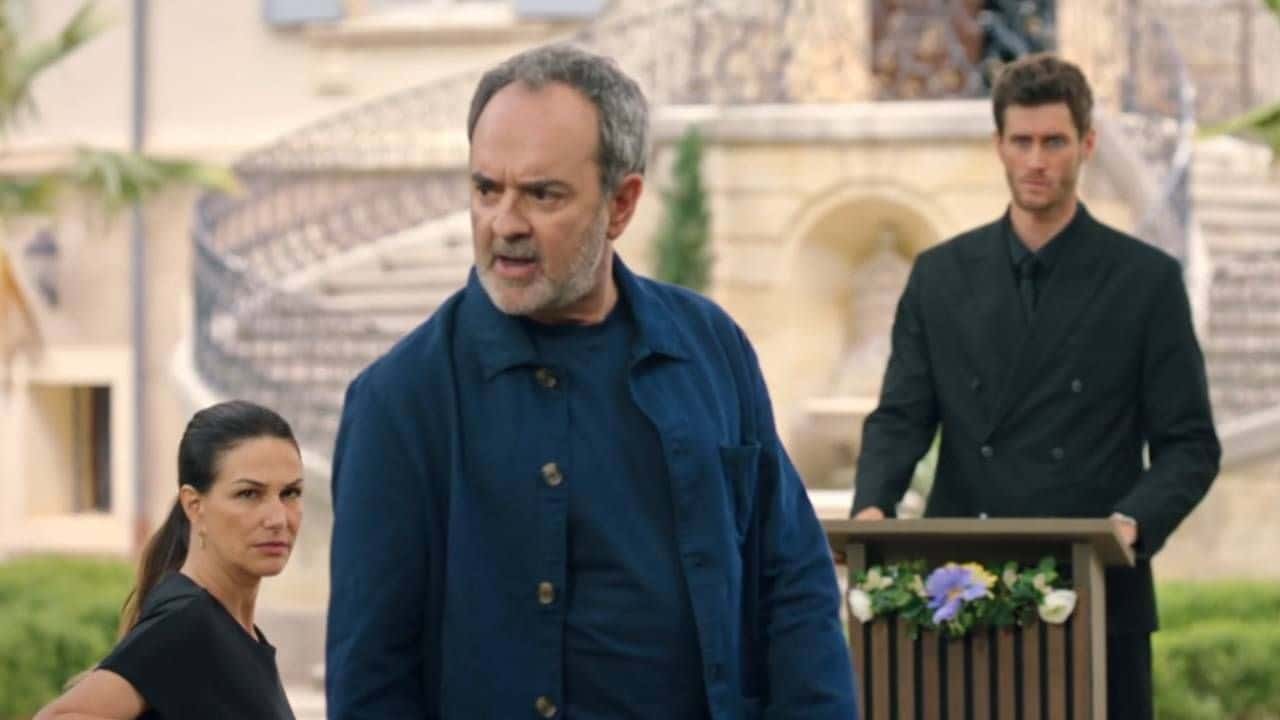
Since June 30, Bruno Solo has starred in “Nouveau Jour,” M6’s latest daily soap opera. A frequent collaborator with the network, the actor is trying his hand at a daily series for the first time. He shares his experiences with us.
Bruno Solo’s relationship with M6 is a longstanding one! Following his roles in “Caméra Café” and “Kaamelott” (which he produced), and the third season of “Les Traîtres,” he’s now appearing in “Nouveau Jour,” the network’s new soap opera.
Set against the backdrop of a four-star hotel, the show features various factions engaged in rivalries, underhanded tactics, and family secrets. The cast includes newcomers like Marion Aymé, as well as well-known actors such as Héléna Noguerra, Jean-Baptiste Maunier, and Bruno Solo himself.
Solo plays Franck, the manager of the Florida nautical club and godfather to Théa. This seemingly charming, gruff but kind-hearted character reveals new depths in the ongoing episodes.
AlloCiné: How did you come to join “Nouveau Jour”? You have a long history with M6 (“Caméra Café,” “Les Traîtres,” “Pékin Express”). It seems this is your first time in a daily soap opera.
Bruno Solo: Yes, and it’s a first for many of us in the cast. There are several reasons I wanted to join “Nouveau Jour.” One is certainly my special bond with M6, a relationship of affection and gratitude.
M6 was the first network to agree to produce “Caméra Café” after years of struggle, and it was a huge success. I then produced or co-produced other series, including “Kaamelott,” where I served as executive producer. My connection with M6 is quite fond, and I’ve also done a lot with public television, from dramatic TV movies to historical shows.
Then I read the scripts, and I really liked them. Not just the series itself, but selfishly, I was particularly drawn to my character’s dramatic arc and development. It’s a fascinating role for an actor, a somewhat old-fashioned, big-hearted character who suddenly shifts into paranoia, violence, and pain due to a terrible tragedy following his wife’s disappearance.
As you mentioned, Franck is a kind character, previously more in the background, who is now central to the plot. We see a new side of him. He’s a broken man, still suffering from his wife’s departure, and harboring deep resentments that are about to erupt. How did you approach this transformation, especially given the intense pace of a daily soap opera?
Indeed, having the experience of a seasoned actor who has played many different roles helps. It requires perhaps a bit less effort than it might have a few years ago. After nearly 40 years in the business, that experience definitely helps, and that’s part of the challenge of daily series.
Even the younger, less experienced actors in the cast have to adapt to this. It’s quite remarkable in daily shows, regardless of the network, how adept actors are at suddenly changing attitudes, moods, and shifting from one emotion to another with great skill.
Sometimes, it’s more or less successful from the audience’s perspective, which I understand, but as far as possible, it’s part of the job description. And I enjoy it. I trained quite a bit over the years with “Caméra Café,” which allowed us to switch moods, sometimes within the same scene, even though it was filmed in a single shot.
I do a lot of preparation upfront. That means I have the dramatic arcs of my fellow actors to understand where they are, and of course, my own arc to focus on. I can start to introduce subtle cues in his behavior that hint at his mood swings, and that certainly requires preparation. Not everyone realizes this, and it’s not for the audience to know the internal workings of each actor, but there’s a lot of preparation involved in the character.
If you approach the scenes without considering where you’ve come from and where you’re going, it shows in the performance. We’re fortunate to have writers who give us a bit of a heads-up on the characters’ dramatic arcs. Moreover, because of my career and some level of notoriety, I’ve earned the right to discuss my character’s development extensively with the writers and make suggestions. This also helps me build my role with more confidence than if I were just thrown into the deep end.
With your experience on previous projects, how much do you allow yourself to tweak the dialogue or scenes? At what level do you get involved?
At a level I consider reasonable and the writers consider reasonable. I’m not the most accommodating in this regard. I’ve negotiated extensively upfront so I don’t have to defend dialogue that might seem inconsistent with the character’s psychology. In daily shows, the writers are sometimes under tight deadlines. For instance, I believe on “Ici, tout commence,” they shoot almost 18 to 20 minutes of useful footage per day, which is nearly one episode per session.
We in “Nouveau Jour” aren’t quite there yet. I’m not saying it won’t happen as the series hasn’t quite met the success hoped for, and there might be adjustments. But I hope one of the main adjustments won’t be forcing us to shoot under tight deadlines. In such cases, the authors might prioritize the situation at the expense of character development. It’s crucial to maintain this vigilance, and I have it. I’m not saying I’m the only one, but I’m among those actors who do, and it’s my duty to remind the writers of this.
That’s what’s so exciting about this venture, which I haven’t experienced before, not with this intensity, this density. We have an obligation to be very attentive to what’s written and see if it matches the characters. This shows that it’s a collective enterprise, where everyone must pay attention to the work of others, to their partners, the authors, the directors. We, the actors, must know our lines well because we don’t have time for many retakes. We can’t hesitate on set, so we work ahead of time. We have coaches who allow us to rehearse the sequences beforehand, and we can call them if we have concerns.
You share most of your scenes with two young actors, Vinicius Dos Santos Lagier, who plays Adrian, and Marion Aymé, who plays your goddaughter, Théa. How have these collaborations been?
We met a bit ahead of time as we did readings about 15 days before shooting. We had time to discuss the characters’ journeys. I discovered a passionate Vinicius, with a sensitivity that’s very close to the surface, but who also exudes a certain strength. He has this imposing physique, yet at the same time, a very childlike smile.
I immediately noticed something unique about him in his approach to scenes. Sometimes, he might be too passionate in his suggestions, but what’s great about Vinicius is that he corrects himself very quickly. He has the humility and intelligence to listen to what his partners or the director tell him.
As for Marion Aymé, she is impressive. I really want to emphasize that she is the true heroine of the series! Théa connects every plotline. Marion is always true to her character. She’s understated in her effects and, unlike Vinicius, she waits for us to push the boundaries. She always offers something remarkably restrained and waits for us to help her go further.
I remember a scene we shot where she refuses to believe that Lucien, her grandfather, could have killed Marion, my wife. She’s moving because you can feel she’s torn between the possibility that it might be true and her denial, her refusal to accept that her grandfather could be a villain. She nailed it in three takes with the experience she has, which is that of a young actress.
It’s worth noting that many of the young actors come from the theater; they perform in troupes in Montpellier and the surrounding areas. They already knew each other well, as they were together in classes. They are incredible. In fact, Marion Aymé very kindly asked me to be her godfather in the profession, and I accepted with great emotion.
What can viewers expect in the upcoming episodes?
My character will find some peace, as he has no choice but to go through a painful mourning process regarding Marion and Lucien. He needs to find some tranquility to continue living, for himself and for Théa as she too faces serious challenges with her family. I can’t say too much, but viewers who follow a soap like “Nouveau Jour” know well that after the calm, another storm is likely on the horizon!
“Nouveau Jour,” Monday to Friday at 1:30 PM on M6, and on replay on M6+.
Similar Posts
- Breaking News: M6 Shakes Up ‘Nouveau Jour’ Series Schedule – Full Details Inside!
- Helena Noguerra Reveals Her Biggest Surprise Becoming the Star of M6’s “Nouveau Jour”
- First Look at M6’s New Series ‘Nouveau Jour’ – We Loved It!
- “Working at the Bartoli Hotel was Théa’s Dream!” Marion Aymé Reveals All About Nouveau Jour Role
- M6’s New Show “Nouveau Jour” Reveals Mysterious Heroes: Bruno Solo, Vincent Desagnat, Gabrielle Atger!

A passionate journalist, Iris Lennox covers social and cultural news across the U.S.