
Sometimes, a change in era brings about a newfound awareness. This was certainly the case for the legendary director John Ford, who dedicated several of his later films to amending his earlier missteps.
John Ford could be a tyrannical figure on set, often shouting harsh words at his actors, yet he remains one of the greatest American film directors. During the 1960s, in his sixties, he began to reconsider how he had portrayed America in his films.
The “Apology” Western: Cheyenne Autumn
Perhaps the most notable example from this period is his 1964 western, Cheyenne Autumn, which features Native American heroes taking control of their fate and leaving the reservation where they were seemingly placed to await death in obscurity.
As Peter Wollen notes in his book Signs and Meaning in the Cinema: “Throughout his career, Ford witnessed the evolving dynamics of civilized/savage and European/Native American. In Cheyenne Autumn, the Europeans are the savages and the natives are the heroes.”
While it would be unfair to say Ford always depicted Native Americans negatively—he demonstrated a more nuanced view in films like Wagon Master and Fort Apache—it’s true that in many other films, Natives were often portrayed as bloodthirsty and deserving of a Winchester bullet.
But in the 1960s, Ford’s perspective was changing, and he aimed to explore different themes in his westerns, including challenging other racist stereotypes prevalent in the genre.
Sergeant Rutledge, a Clumsy Attempt
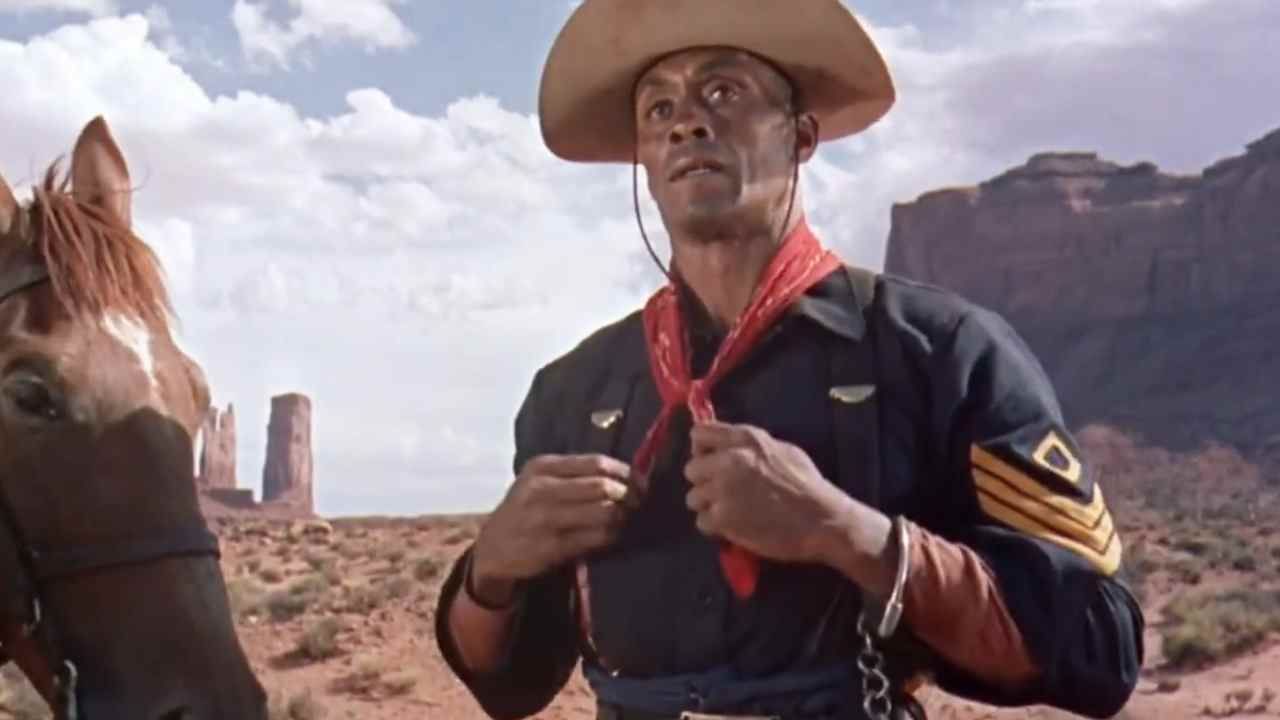
Ford also tackled the issue of racism in the 1960 film Sergeant Rutledge, starring Woody Strode, albeit with less subtlety and several missteps. He wanted to address decades of racism in Hollywood.
Casting an African American as the lead in a major film was a bold move at the time, and Ford had to clash with his studio’s head to push the film’s subject at a time when part of America was fighting for civil rights. However, the director quickly shifted from the contentious issue to pit one ethnicity against another: Blacks and Native Americans.
He also focused on giving significant roles to female characters, particularly in his last completed film, 7 Women. Women in Ford’s films were often relegated to secondary roles or had to deal with men driving the action. In 7 Women, they are central to the narrative, with Anne Bancroft’s character challenging prevailing prejudices.
The End of Unshakable Myths
By the time of The Man Who Shot Liberty Valance in 1962, Ford was openly stating that the West as sold in cinemas and dime novels was a fantasized version and purely legendary, a sentiment echoed by a famous line from the film.
Moreover, in Cheyenne Autumn, James Stewart’s portrayal of Wyatt Earp is a far cry from Henry Fonda’s in Ford’s earlier My Darling Clementine. Arrogant and lazy, this version of Earp is ridiculed, a stark contrast to the daring sheriff celebrated in many Westerns and pseudo-historical accounts of the West.
The Film That Best Represents Ford at This Time
Ultimately, the film that perhaps best represents Ford during this era is The Last Hurrah with Spencer Tracy. While not a Western, it speaks volumes about the director’s mindset during this phase of his life.
The main character, an aging Irish-American politician who gives his all to win one last election and loses to a younger candidate, could be seen as Ford (also of Irish descent) trying to deliver his cinematic testament before it was too late, in the face of New Hollywood and the incoming hippie culture that would change everything.
John Ford passed away in 1973, the year when Henry Fonda, the hero of his films from the 1930s and 40s, played a self-parody opposite Terence Hill in the Italian Western My Name is Nobody. Ford’s name, however, was legendary.
Similar Posts
- Harrison Ford Almost Lost Yellowstone 1923 Lead on Netflix – Here’s Why!
- John Wayne’s Most Stylish Western Revealed! Find Out Which One!
- Harrison Ford Action Flick May Get Sequel After Earning $300M Globally 28 Years Ago!
- Harrison Ford Missed Out on an Oscar-Worthy Role 20 Years Ago! Here’s Why
- Can You Recognize This Mega Movie Star in His First Role Ever?

A passionate journalist, Iris Lennox covers social and cultural news across the U.S.